Sail smarter, float better

Table of Contents hide
Reefing means making the mainsail smaller so the boat stays upright and under control as the wind builds. Sailmakers and sailing schools give the same rule: reef early, as soon as you first wonder whether you should. The core sequence on most boats is short: support the boom, ease the mainsheet and vang, lower the halyard to the reef, secure the new tack, re-tension the halyard, pull the new clew down with the reefing line, and trim again.
This guide covers cruising boats of roughly 25 to 40 feet with a slab-reefing (jiffy-reefing) main, plus single-line reefing, furling mains and the headsail. Every boat is rigged a little differently, so check it against your own setup. Sources were read on 14 November 2026.
Key Takeaways
- Reef early: the time to reef is when you first think of it, not after the rail is in the water or a squall has arrived.
- Depower first: support the boom, then ease the mainsheet and vang before you lower anything.
- Luff, then leech: most sailmakers secure the new tack and tension the halyard before pulling the clew down.
- Tie around the sail, not the boom: reef points gather the folded sail only; tying them around the boom can tear the sail.
- Shake out carefully: untie every reef point before you ease the reefing line and hoist.
What Reefing Does and Why It Matters
As the wind increases, a full mainsail produces more heeling force than the boat can use. The boat lies over, the helm loads up as it tries to turn into the wind (called weather helm), and the boat slips sideways more. Yachting Monthly notes that few boats sail efficiently once heel passes about 25 degrees. Reefing reduces the area of the sail, so the heeling force drops.
A reef also changes the sail's shape. Cruising World explains that a reef repositions the mainsail's centre of effort, and that a reefed boat is often faster, safer and more comfortable than an overpowered one. Less load also means less strain on the sails, rig and crew.
Reefing terms
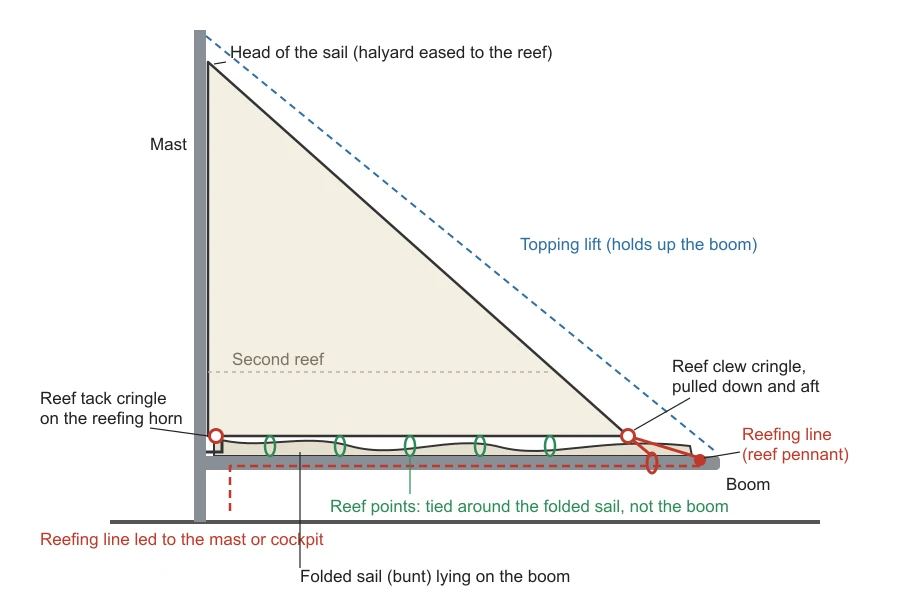
- Tack and clew: the lower front and lower back corners of the sail. Each reef has its own tack and clew, a little higher up.
- Cringle: a reinforced ring in the sail. The reef tack cringle sits on the luff, the reef clew cringle on the leech (the back edge).
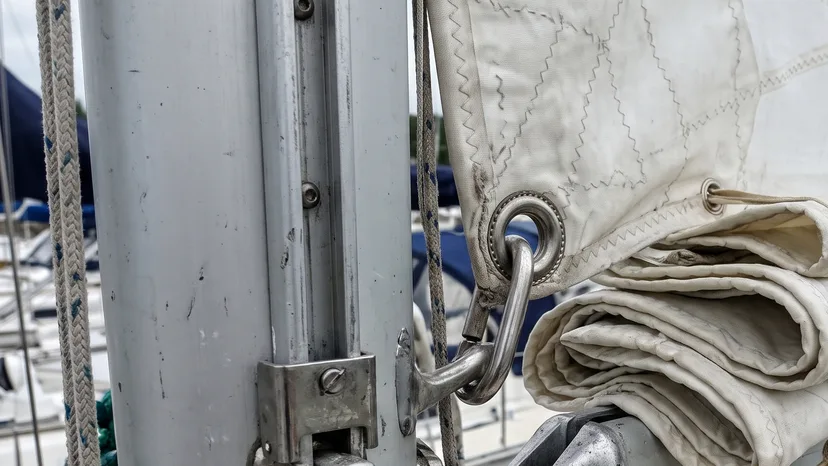
- Reefing horn (or reef hook): a fitting at the gooseneck, where the boom meets the mast, that holds the reef tack cringle.
- Reefing line (reef pennant): the line that pulls the reef clew cringle down to the boom.
- Reef points (reefing ties): short ties or lines along the reef band that gather the folded sail.
- Topping lift and vang: the topping lift holds the boom up; the vang (or kicker) pulls it down, and a rigid vang can also hold it up.
When to Reef
The common advice is simple: reef as soon as you start wondering whether to. Practical Sailor points out that reefing after a gust has already hit is stressful and can lead to an accidental gybe.
Signs that it is time to reef:
- the boat heels more than is comfortable or efficient, and the rail starts to go under;
- the helm gets heavy and you have to fight the boat to keep it from rounding up;
- steady whitecaps, other boats heeled well over, or a darkening sky upwind (whitecaps and heeled boats are Quantum's signs, the darkening sky is Practical Sailor's);
- a squall or a front is coming, or the forecast says the wind will build.
Squalls deserve special care. Practical Sailor's squall guide recommends shortening sail early, since the first gust can arrive well ahead of the cloud and rain, and a conservative sail plan at night.
Is there a wind speed for reefing?
There is no single number, because it depends on the boat. Light, tender boats need to reef sooner than heavy, stiff ones, and the same wind feels very different upwind and downwind. Published guidance varies:
- NauticEd suggests a first reef at about 12 to 16 knots and a second at about 18 to 22 knots.
- Yachting Monthly gives about 18 knots of apparent wind upwind for a typical medium-size cruiser, while noting that light coastal boats may struggle at 15 knots and heavier offshore designs may carry full sail past 20 knots.
- UK Sailmakers places a single deep reef on most cruising boats in roughly 18 to 25 knots and a second reef in roughly 22 to 30 knots.
Treat these as starting points; your boat's heel and helm tell you more than any table.
How to Reef a Mainsail Step by Step (Slab Reefing)
Slab reefing is the traditional system: each reef has a tack cringle that goes on a horn at the gooseneck and a clew cringle pulled down by its own reefing line. Sailmakers order the steps slightly differently; the sequence below follows North Sails and Quantum, which both put luff tension before the clew.
- Get ready. Brief the crew, clip on if anyone is going forward, and make sure the halyard is free to run and the reefing line is ready to haul. North Sails suggests flaking the halyard and putting it on a winch first.
- Support the boom. Take up the topping lift so the boom will not drop into the cockpit when the sail comes down. Elvstrøm notes that this is not needed with a rigid kicker (vang) that supports the boom.
- Depower the main. Ease the vang completely and ease the mainsheet until the main spills wind. Cruising World warns that not releasing the vang can damage the luff hardware.
- Lower the halyard to the reef. Ease the halyard until the reef tack cringle reaches the gooseneck. A mark on the halyard for each reef makes this quick: Practical Sailor suggests one mark for the first reef and two for the second.
- Secure the new tack. Put the reef tack cringle over the reefing horn or hook, or pull it down with the tack line if your boat has one. Keep it down and forward; North Sails notes that otherwise the slides take the load.
- Re-tension the halyard. Hoist until the luff is firm again. Quantum treats luff tension as the first priority.
- Pull down the clew. Haul in the reefing line until the reef clew cringle is down on the boom and the new foot is tight. The line should pull aft as well as down, so the reefed sail stays flat.
- Trim. Ease the topping lift if you used it, sheet the main back in and re-set the vang.
- Tie in the reef points. Gather the folded sail neatly and tie each reef point around the bunt only, not around the boom. North Sails, Quantum and UK Sailmakers all advise this: the reefing line carries the load, and if it fails, ties around the boom can tear the sail. UK Sailmakers adds that they also distort the shape and cause chafe.
Some guides pull the reefing line before the final halyard tension, especially on single-line systems. The goal is the same: a firm luff, a tight foot and a flat sail.
How the reefing line runs
On most slab-reefing setups, the reefing line comes out of the boom near its end, goes up through the reef clew cringle and back down to the boom, where it is tied off. Elvstrøm and North Sails describe finishing it around the boom with a bowline or similar hitch, and North Sails notes that the line should meet the boom a little aft of the cringle so it pulls the clew aft as well as down. The other end may be cleated at the boom or led forward along the boom and back to the cockpit.
Loose-footed mainsails
On a loose-footed main (attached to the boom only at the tack and clew), there is no foot in a boom track to work around. Quantum suggests rolling the reefed part neatly and securing it with sail ties or heavy shock cord, again without tying it to the boom.
Reefing on Different Points of Sail
The sail has to be depowered before it will come down, and how you do that depends on the wind angle. The sources disagree on the details, so choose the approach that suits your boat and the sea state.
- Close-hauled or close reach, main eased. This is the approach most sources prefer (see our guide to the points of sail if the terms are new). Practical Sailor suggests sailing between close-hauled and a close reach with the jib still drawing, which keeps the boat moving and steering while the main spills wind. Elvstrøm recommends reefing on the wind on a steady course.
- Head to wind. Pointing straight into the wind takes all load off the main, but the sail and sheets flog. NauticEd says it is possible but the flogging is dangerous; Elvstrøm calls it wrong and dangerous.
- Downwind. With the wind behind, the main presses against the spreaders and shrouds and cannot be fully depowered. Yachting Monthly advises rounding up to a beam reach to reef. SAIL argues the opposite: rounding up increases the apparent wind sharply, and you can pull the sail down while still running. Yachting Monthly's advice is to reef early and deep.
Reefing while hove to
Heaving to parks the boat with the jib backed and the helm to windward. Cruising World recommends it for reefing short-handed:
- Tack without releasing the jib sheet, so the jib backs.
- Put the helm to windward and lash or hold it.
- Ease the main until it almost luffs.
- Take in the reef as above.
- Sheet the main back in, release the jib and tack back onto your course.
Single-Line Reefing
Single-line reefing uses one line per reef to pull down both the tack and the clew. The line runs through the boom and blocks so that it first pulls the luff down to the gooseneck, then pulls the leech down. SAIL calls it the most popular slab-reefing method because you can reef from the cockpit without going to the mast.
The trade-off is friction. Quantum notes that friction can be significant, especially when the line is led to the cockpit, and that blocks at the tack and clew work better than plain eyelets. SAIL adds that if a line breaks, the lines can jam inside the boom, and that single-line systems are usually fitted only for the first two reefs.
| System | Where you work | Strengths | Drawbacks |
|---|---|---|---|
| Slab (two-line) | At the mast, or the cockpit if both lines are led aft | Simple, with less friction than a single-line system | Someone may have to go forward to the mast |
| Single-line | Cockpit | One line per reef, no trip to the mast | Friction, a broken line can jam in the boom, usually only two reefs |
| In-mast furling | Cockpit | Easy to set and reef to any size | Flatter sail with no battens or roach; can jam |
| In-boom furling | Cockpit | Battened sail rolled into the boom | Boom angle must be right or the sail rolls badly |
In-Mast and In-Boom Furling Mains
With a furling main, you reef by rolling the sail away to the size you want instead of tying in a slab. Cruising World explains the main points:
- In-mast furling is easy to set and reef, but the sail is flatter, with no full battens or roach. Overloading the outhaul or using a powered winch can jam the sail in the mast slot, and Good Old Boat warns that a jammed in-mast sail may be impossible to lower.
- In-boom furling rolls a battened sail into the boom. The angle between boom and mast is very important for the sail to roll evenly, and a strong vang holds it there.
Follow your furler maker's instructions for the order of easing and pulling lines; the procedure differs between systems. Practical Sailor notes that reefing a furling main early, before the load builds, reduces the strain on the system.
How to Reef a Jib or Genoa
Most cruising boats reduce the headsail by rolling part of it onto a roller furler. The steps in Quantum's guide are:
- Ease the sheet and turn toward the wind to take the load off the sail (Quantum says head to wind).
- Pull in the furling line to roll the sail to the size you want.
- Secure the furling line and re-trim the sheet.
If the furling line is hard to pull, ease the sheet more and look for friction instead of putting the furling line on a winch, which Practical Boat Owner advises against except on large yachts with furlers built for it. The sheet lead also changes as the sail gets smaller; Practical Boat Owner suggests adjusting it so the telltales fly together at each reef mark.
A rolled headsail loses shape. Quantum notes that only about 30 percent of a genoa can be rolled before it stops setting well, and that a foam or rope luff pad helps.
Is it okay to sail with just the jib?
You can, and some boats balance well under headsail alone, but it has limits. James Stevens writes in Yachting Monthly that upwind under jib alone the bow tends to be knocked off by the waves, and that a fractional rig's small jib may lack the power to drive the boat. Practical Sailor notes that sailors who only reduce the headsail and leave the main full can lose steering control.
Shaking Out a Reef
Shaking out a reef reverses the process, and the rule that matters most is to untie every reef point first. The sequence in NauticEd's guide is:
- Ease the mainsheet.
- Untie all the reef points and check that none is left.
- Ease and unhook the tack.
- Ease the reefing line.
- Hoist the main to full height.
- Trim the sail and make sure the topping lift is slack.
UK Sailmakers' reefing refresher warns that a forgotten reef point is an easy mistake at night and can rip the sail when you hoist; high-contrast ties are easier to spot.
Safety When Reefing
- Clip on. If you go forward to the mast, clip your tether to a jackline or a strong point. Cruising World stresses this especially at night, and Practical Sailor recommends a life jacket and/or harness when reefing.
- Reef from the cockpit if your boat allows it. SAIL notes that cockpit reefing is the main reason sailors choose single-line or led-aft systems; it means less time on deck.
- Practise in easy conditions. North Sails suggests practising at the dock and in moderate wind, and Good Old Boat says a strong blow is not the time to learn. Then a reef in rough weather is a routine you already know.
For the broader safety basics, including life jackets and weather checks, see our basic sailing rules and safety guide for new sailors.
Common Reefing Mistakes
- Reefing too late. Cruising World puts it bluntly: if the rail is buried, you are well past the time.
- Not easing the vang. The sail will not come down cleanly, and the luff hardware can be damaged.
- Getting the topping lift wrong. NauticEd notes that a slack topping lift lets the boom drop, while one left tight stops the reefing line from pulling the leech down.
- Tying reef points around the boom. It can tear the sail if the reefing line fails.
- Hoisting with a reef point still tied. Check every tie before you hoist.
Frequently Asked Questions
What does it mean to reef a sail?
Reducing the sail's area in stronger wind, by tying down part of the mainsail along the boom or rolling part of a furling sail away.
When should you reef, and at what wind speed?
As soon as you first think about it. Published starting points for a first reef range from about 12 to 16 knots (NauticEd) to about 18 knots upwind for a medium cruiser (Yachting Monthly); your boat, the point of sail and the sea decide.
Is 20 mph of wind too strong for sailing?
Twenty miles per hour is about 17 knots. On the Beaufort scale published by NOAA, 17 to 21 knots is Force 5, a fresh breeze with many whitecaps. Many cruising boats can sail in it, but it is around the range where the sources above suggest a first reef, and it can be too much for small boats, new crews or rough water. Check the local forecast and any advisories before you go.
Can you reef while hove to?
Yes. Heaving to backs the jib and slows the boat, which makes reefing calmer, especially short-handed (see the steps above).
How many reefs should a mainsail have?
Two reefs is typical for a cruising mainsail, and Quantum says two are plenty if you do not plan to sail offshore. UK Sailmakers says one reef suits many coastal cruisers but a second should be there once you sail beyond your home waters, and a third is mainly for offshore sailing.
What is the difference between a cunningham and a reef?
A cunningham tightens the luff to flatten the sail and move its fullness forward; Good Old Boat explains that it moves the draft forward and helps flatten the sail. A reef reduces the sail's area.
What is the opposite of reefing a sail?
Shaking out the reef: untying the reef points, freeing the reefing line and the tack, and hoisting the sail back to full size.
Next Steps
Run through a reef at the dock or on a calm day: mark the halyard for each reef and check how your reefing lines run. Then try it under sail in moderate wind. If sail trim and wind angles are still new to you, start with our beginner's guide to sailing a sailboat, and consider a hands-on course; our overview of sailing licenses and certifications explains the options.