Sail smarter, float better

Table of Contents hide
A sailboat's rig type describes how many masts it has, where they stand and which sails they carry. Those few details decide how the boat is named: a sloop, a cutter, a ketch, a yawl, a schooner, a cat rig or a junk rig. The sloop is the rig most people picture when they think of a modern sailboat and the standard rig on production boats, but the others are common on cruising boats, classics and small dinghies.
This guide explains how to recognise each rig, what sailing writers and designers say each one is good and bad at, the difference between masthead and fractional rigs, and how to match a rig to the sailing you plan to do. It covers the arrangement of masts and sails; the wires and lines that hold them up and control them are a separate subject.
Key Takeaways
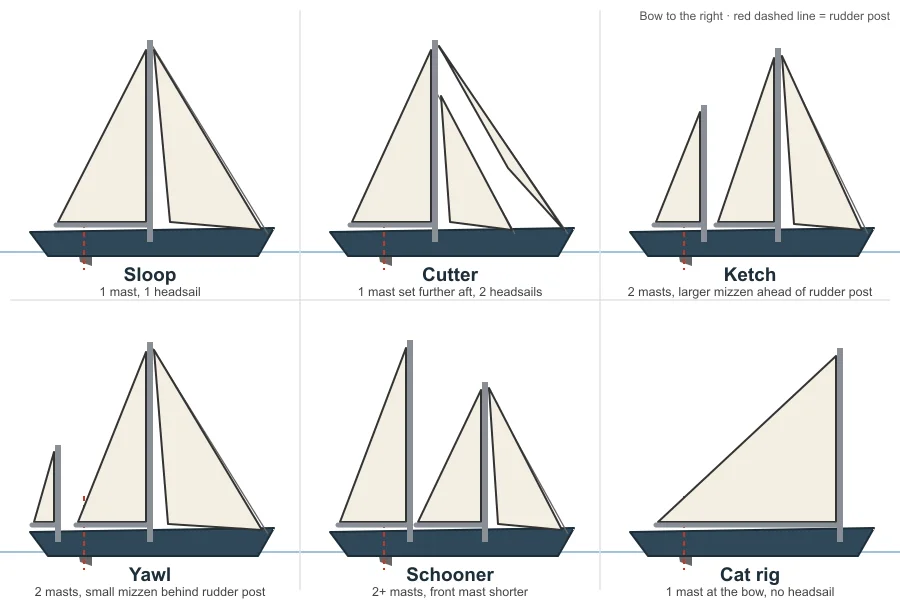
- Three questions identify most rigs: how many masts, where the masts stand, and how many headsails fly in front of the mast.
- Sloop: one mast and one headsail. It is the most familiar rig, simple to handle and good upwind.
- Cutter: one mast with two headsails, a yankee and a staysail, which split the sail area for heavier weather.
- Ketch and yawl: two masts with a smaller mizzen aft. The yawl's mizzen is smaller and further aft; the two are told apart by mizzen size and position.
- No rig is best for everyone: each trades upwind performance, simplicity and cost against sail-handling flexibility.
How Rigs Are Classified
Sailors name a rig by looking at a few features, roughly in this order:
- Number of masts. One mast (sloop, cutter, cat rig), two masts (ketch, yawl, most schooners) or more.
- Where the masts stand. On a two-masted boat, the size and position of the aft mast (the mizzen) separate a ketch from a yawl, and the relative height of the masts marks a schooner.
- Number of headsails. The sails set ahead of the front mast: one on a sloop, two on a cutter, none on a cat rig.
- Shape of the sails. Most modern boats carry a triangular mainsail, called a Bermuda (or Marconi) rig. Older and traditional boats may carry a four-sided gaff mainsail, and junk-rigged boats carry fully battened sails.
The terms describe a boat's usual setup. The same hull is sometimes offered with different rigs, and owners change rigs over the years, so a listing that says "cutter" or "ketch" is worth checking against photos.
Sailboat Rig Types at a Glance
| Rig | Masts | Headsails | How to recognise it | Typical strengths | Typical trade-offs | Common on |
|---|---|---|---|---|---|---|
| Sloop | 1 | 1 | One mast, one jib or genoa | Simple, good upwind, fewer sails and wires | Sails get large and hard to handle on big boats | Production cruisers, club racers, most small keelboats |
| Cutter | 1 | 2 | Mast further aft; a yankee on the forestay and a staysail on an inner stay | Sail area split into smaller sails; a small staysail for strong winds | Tacking the yankee takes more work; often needs running backstays | Offshore cruising boats |
| Ketch | 2 | Usually 1 | A sizeable mizzen, stepped ahead of the rudder post on traditional definitions | Smaller individual sails; can sail on jib and mizzen in a blow | Less close-winded; extra mast, rigging and cost | Larger cruising boats |
| Yawl | 2 | Usually 1 | A small mizzen right aft, behind the rudder post | Mizzen helps balance the boat and steady it at anchor | The mizzen adds little drive | Classic yachts |
| Schooner | 2 or more | 1 or more | Front mast shorter than, or equal to, the main mast | Lots of sail area spread over several sails | Many sails to handle and maintain | Traditional vessels and a few classics |
| Cat rig | 1 | None | One mast right at the bow, one large sail | Very simple to sail and to sail alone; few or no stays on many | Classic cat rigs are weaker upwind | Dinghies such as the Optimist and Laser; catboats |
| Junk rig | 1 or more | None | Fully battened sails with horizontal battens; usually no stays | Easy reefing, quiet sails, no standing rigging to replace | Weaker upwind than a sloop | Traditional Chinese craft; boats of junk-rig enthusiasts |
The Main Rig Types
Sloop
A sloop has a single mast with a mainsail behind it and one headsail, a jib or a genoa, in front. The American Sailing Association (ASA) calls it the rig most of us picture when we think of a modern sailboat, and it is the standard rig on production cruisers, club racers and most small keelboats.
ASA credits the sloop with good upwind ability and simple control, which suits short-handed crews, and notes that fewer wires and sails mean lower maintenance and replacement costs. Its main drawback appears as boats get bigger: with only two sails carrying all the sail area, the sails on a large sloop can become too big to manage easily.
Cutter
A cutter is also a single-masted boat, but it carries two headsails: a high-cut yankee on the forestay and a smaller staysail set behind it on an inner stay. Yachting Monthly notes that a cutter ideally has its mast placed relatively far back to leave room for both stays and sails, and designer Robert Perry, writing in Good Old Boat, describes a true cutter as having a bigger foretriangle than a sloop.
The appeal for cruisers is choice. Yachting Monthly says the rig divides the headsail area into two more manageable sails, and that a staysail sets far better than a partly rolled-up genoa. ASA adds that a reefed main and a small staysail make a balanced sail plan when the wind picks up, and that the staysail makes heaving-to easier.
The costs are work and complexity. Cutters are not quite as easy to tack as sloops, because the yankee has to be pulled through the gap between the two stays, and Yachting Monthly points out that a conventional cutter usually needs running backstays to keep the inner stay tight. A related setup, the Solent rig, sets a narrow jib on the inner stay; unlike a cutter, its two headsails are not meant to be flown together.
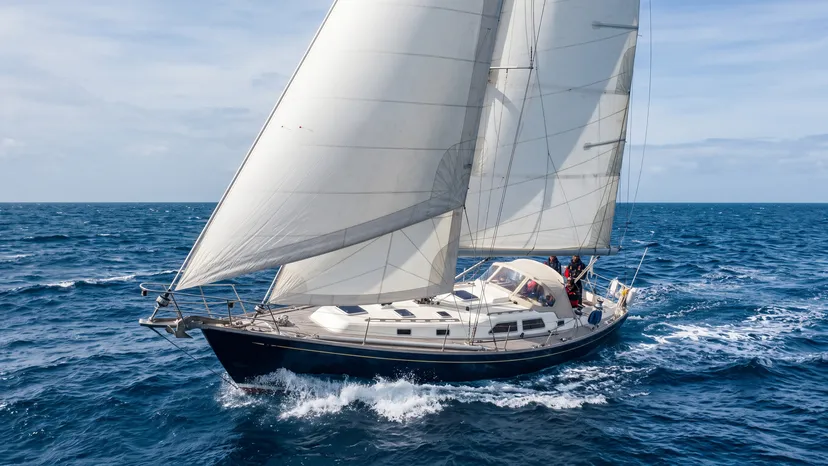
Ketch
A ketch has two masts: a main mast and a smaller mizzen mast behind it. Cruising World columnist Fatty Goodlander, a ketch owner, gives the traditional rule: a ketch's mizzen is stepped forward of where the rudder post meets the waterline, and it is larger than a yawl's.
The idea, as ASA describes it, is to carry plenty of sail while keeping each sail manageable. ASA notes that many ketch sailors drop the mainsail and sail on the headsail and mizzen alone, a combination often called "jib and jigger", which can make for a balanced, comfortable ride in blustery conditions. Goodlander also uses the mizzen as an "air rudder" to balance the helm, to damp rolling at anchor and as a place to mount gear.
The trade-off is performance and cost. Perry writes that if you are after a close-winded boat, the traditional ketch rig is not for you: trimming the mizzen upwind means over-sheeting it, which can add weather helm and slow the boat. He also notes the extra chainplates raise build cost, which he sees as a main reason ketches are rarer on modern boats. Goodlander sums up the downside of a ketch in one word, speed, and adds that in light air a ketch offers few advantages.
Yawl
A yawl also has a main mast and a mizzen, but the mizzen is small and set right aft, behind the rudder post according to ASA. Sailors who like the rig use the mizzen for balance, as an "air rudder", to help heave to and to keep the boat steady at a mooring.
Even fans concede the yawl's mizzen adds little drive; ASA says it provides hardly any horsepower, and that many sailors see the yawl as more pretty than efficient. ASA adds that some sailors argue the rig was a "rule beater", designed to gain an advantage under the racing rules of its day. Yawls are mostly found among classic designs.
Ketch or yawl? The rudder-post rule is the textbook test, but Perry argues it does not work reliably on modern boats, where rudders sit in different places. He goes by proportion instead: a small mizzen stepped well aft makes a yawl, a large mizzen stepped further forward makes a ketch. In practice the two tests usually agree.
Schooner
A schooner has at least two masts, and the front mast (the foremast) is shorter than, or the same height as, the main mast behind it. That is the reverse of a ketch or yawl, where the taller mast is in front. ASA notes that most schooners had two masts, though some had more.
Schooners were fast and versatile working boats in their day, but ASA describes the rig as a lot of work and a lot to maintain, and says sloops and yawls later replaced it because they sailed better upwind and were easier to manage. Perry calls the modern schooner rig largely an aesthetic statement. ASA presents the rig as largely historical today.
Cat Rig (Catboat)
A cat rig has a single mast set well forward, near the bow, carrying one large sail and no headsail. ASA describes it as having no standing rigging, and lists dinghies such as the Optimist and the Laser as familiar examples. The name has nothing to do with catamarans: a catboat is a single-hulled boat, and "cat rig" describes its sail plan.
ASA lists the rig's strengths as simplicity, quick tacking, easy single-handing, lower costs with no stays to maintain or replace, and roomy cabins on bigger boats because the mast sits so far forward. Perry describes catboats as "one string" boats once the sail is up. The usual weakness of classic cat rigs is upwind performance; ASA notes that some modern designs use a wishbone boom to address it.
Junk Rig
A junk rig uses fully battened sails, with stiff horizontal battens running across the whole sail, usually on masts without stays or shrouds. ASA traces it back to Chinese sailing craft as early as the 10th century.
Junk-rig owners, ASA reports, say the sails are extremely easy to reef in a breeze, tack by themselves, do not flog or flap, and perform well downwind. With no standing rigging there is nothing to inspect or replace aloft. The concession is upwind performance: ASA says the best owners hope for is to come close to how a sloop sails to windward.
Masthead vs Fractional Rigs
Within single-masted rigs, sailors also distinguish where the forestay meets the mast. In SAIL magazine, Peter Nielsen describes the two traditional types:
- Masthead rig: the forestay is attached at the top of the mast, traditionally with straight spreaders. It carries large headsails and a smaller mainsail. SAIL notes a masthead rig is generally easier for an owner to tune, and its big headsails can sail the boat well without the main.
- Fractional rig: the forestay is attached lower, about three-quarters to seven-eighths of the way up the mast, with swept-back spreaders. It carries a larger mainsail and a smaller jib, many fractional boats sail well under mainsail alone, and the mast is designed to be tuned with adjustable backstay tension.
SAIL adds that the line between the two has blurred: many production boats now use a near-masthead rig with the forestay at about 19/20ths of the mast height, and swept spreaders are common on cruising masthead boats too. Perry calls the modern fractional sloop a nice rig for ease of handling, with a small jib that has little overlap. For many years, SAIL notes, fractional rigs were found mostly on racer-cruisers rather than pure cruising boats, while boats designed to the racing rules of the time were usually masthead-rigged. On a fractional rig, reefing the large mainsail early is the main way to reduce power; our guide on how to reef a mainsail covers the steps.
Other Rig Terms You Will See
- Bermuda or Marconi rig: a triangular mainsail set behind the mast. Most modern sloops, cutters and ketches are Bermuda-rigged.
- Gaff rig: a four-sided mainsail whose top edge is held up by a spar called a gaff. ASA notes gaff rigs fell out of favour after the Bermuda rig arrived, mainly because they were weaker upwind, though supporters cite less heel and more reefing options. "Gaff cutter" or "gaff ketch" means the rig type with gaff sails.
- Solent rig: a sloop with a second, inner forestay for a smaller jib, used instead of the genoa rather than with it.
- Running backstays: adjustable stays from the mast to the sides of the stern, set up on the windward side. Conventional cutters usually need them to keep the inner stay tight.
- Unstayed or freestanding mast: a mast with no shrouds or stays, typical of cat rigs and junk rigs.
- Square rig: sails hung from yards across the mast, as on traditional tall ships. It is rarely seen on yachts.
Which Rig Suits Your Sailing?
None of the sources above names one best rig. They describe trade-offs, and which ones matter depends on how and where you sail:
- Daysailing, club racing and learning: a sloop or a cat-rigged dinghy. ASA credits the sloop with good upwind ability and simple handling, and the cat rig with simplicity and quick tacking; Perry calls the modern fractional sloop a nice rig for ease of handling.
- Coastal cruising: a sloop is the usual choice, and SAIL notes that many production boats now use a near-masthead rig. A cutter, or a Solent-style inner stay, adds a small headsail for heavier weather.
- Offshore and bluewater cruising: ASA describes the cutter as a rig cruisers often choose for offshore work, and Yachting Monthly says it splits the headsail area into two more manageable sails. Ketch owners such as Goodlander value smaller sails in heavy weather. Both rigs cost some upwind speed and add gear, as the sections above explain. Our guide to the best sailboats for sailing around the world shows how this plays out on proven bluewater designs.
- Short-handed and singlehanded sailing: ASA notes that sloops suit short-handed crews and cat rigs are easy to single-hand, while junk-rig owners report very easy reefing at the cost of upwind performance. Choose the simplest rig you can handle from the cockpit.
- Classic boats: yawls, gaff rigs and schooners. ASA describes the schooner as a lot of work and a lot to maintain.
On a used boat, the rig's condition matters more than its type: a second mast means a second set of standing rigging, chainplates and fittings to inspect. Our guide to buying an older sailboat covers what a survey and rig check should look at.
Frequently Asked Questions
What is the most common sailboat rig?
The sloop: one mast with a mainsail and a single headsail. The American Sailing Association calls it the rig most people picture when they think of a modern sailboat, and most production cruising and racing boats use it.
What is the difference between a ketch and a yawl?
Both have a main mast and a smaller mizzen mast behind it. On a ketch the mizzen is larger and, traditionally, stepped ahead of the rudder post; on a yawl it is small and stepped behind the rudder post. Designer Robert Perry suggests judging by the mizzen's size and position, since the rudder-post rule does not always work on modern boats.
What is the difference between a sloop and a cutter?
Both have one mast. A sloop flies one headsail; a cutter flies two, a yankee on the forestay and a staysail on an inner stay, and usually has its mast further aft. The cutter offers more sail combinations for strong winds but takes more work to tack.
Is a ketch good for bluewater sailing?
Many bluewater sailors like ketches because the sail area is split into smaller sails, and the boat can sail on jib and mizzen in strong winds. The trade-offs are weaker upwind performance and the cost of a second mast and its rigging. Whether that suits you depends on the boat and on how much upwind sailing your routes involve.
What is a fractional rig?
A rig in which the forestay meets the mast below the top, typically at three-quarters to seven-eighths of its height, with swept-back spreaders. It carries a larger mainsail and a smaller jib, and the mast is tuned with adjustable backstay tension.
What is a junk rig?
A rig with fully battened sails, usually on masts without stays. It originated on Chinese sailing craft. Owners value its easy reefing and lack of standing rigging; its main weakness is upwind performance compared with a sloop.
Next Steps
Next time you walk a marina, count the masts, look for an inner stay and check where the forestay meets the mast: you will be able to name most rigs at a glance. If you are new to the parts of a boat, our beginner's guide to sailing explains the mast, boom, mainsail and jib, and how to sail with them.