Sail smarter, float better

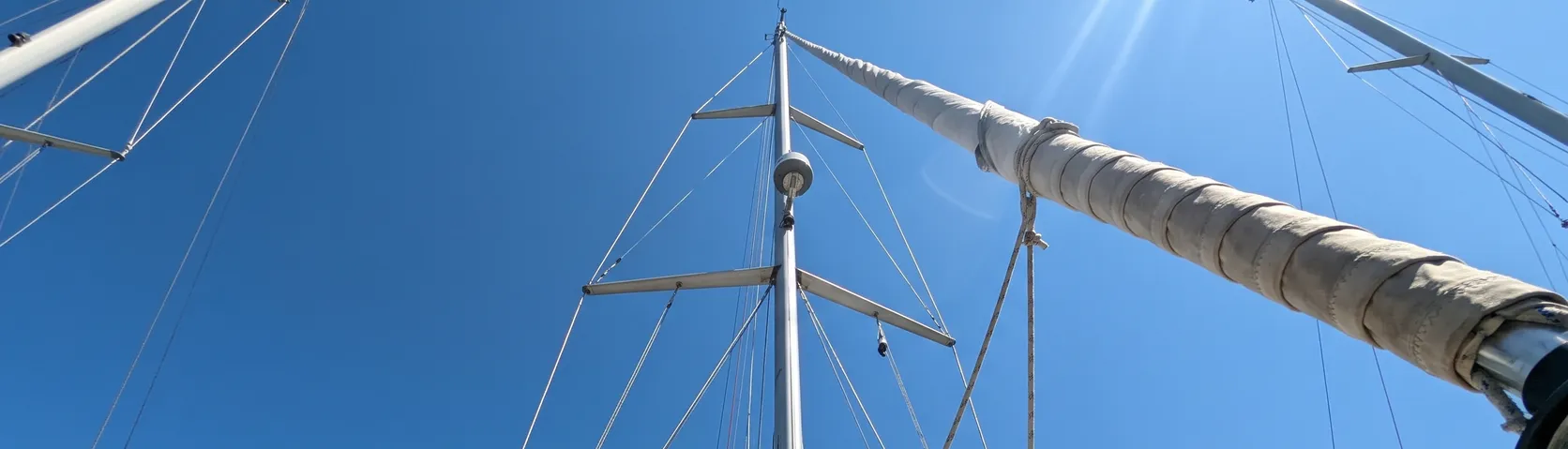
Sailboat rigging is all the wire and rope that holds a mast up and controls the sails. Step aboard for the first time and it can look like a tangle of cables and lines, but every piece has a name and a single job. Once you know the names, a survey report, a rigger's quote or a skipper shouting "ease the vang" starts to make sense.
Rigging falls into two groups. Standing rigging is the fixed wire that keeps the mast upright. Running rigging is the rope you pull and ease to hoist, trim and reef the sails. This guide explains both with a labelled diagram, part by part. How many masts a boat has and how its sails are arranged is a separate question, covered in our guide to sailboat rig types.
Key Takeaways
- Two groups: standing rigging holds the mast up and stays set; running rigging moves the sails and is adjusted all the time.
- Stays and shrouds: stays (forestay, backstay) support the mast fore and aft; shrouds support it from the sides, held out by spreaders and anchored at chainplates.
- Halyards and sheets: halyards raise and lower sails; sheets set their angle to the wind. Traveler, vang, outhaul and cunningham fine-tune the mainsail's shape.
- Materials differ: standing rigging is usually stainless steel wire; running rigging is rope, usually polyester, with low-stretch fibres for halyards.
- Failure costs differ: a worn sheet is a nuisance, but a failed stay, shroud or chainplate can bring the mast down, so structural rigging needs regular expert inspection.
Standing vs Running Rigging at a Glance
| Feature | Standing rigging | Running rigging |
|---|---|---|
| What it does | Holds the mast up and carries the loads from the sails into the hull | Hoists, lowers, trims and reefs the sails |
| Adjusted while sailing? | Rarely; set when the rig is tuned (an adjustable backstay is the common exception) | Constantly |
| Typical materials | Stainless steel wire; rod or synthetic fibre on some boats | Rope: polyester, or low-stretch fibres such as Dyneema |
| Main parts | Forestay, backstay, shrouds, spreaders, chainplates, turnbuckles, terminals | Halyards, sheets, traveler, boom vang, outhaul, cunningham, topping lift, reefing lines, furling line |
| How it wears | Fatigue and corrosion, often hidden inside fittings | Chafe, UV and stretch, usually easy to see |
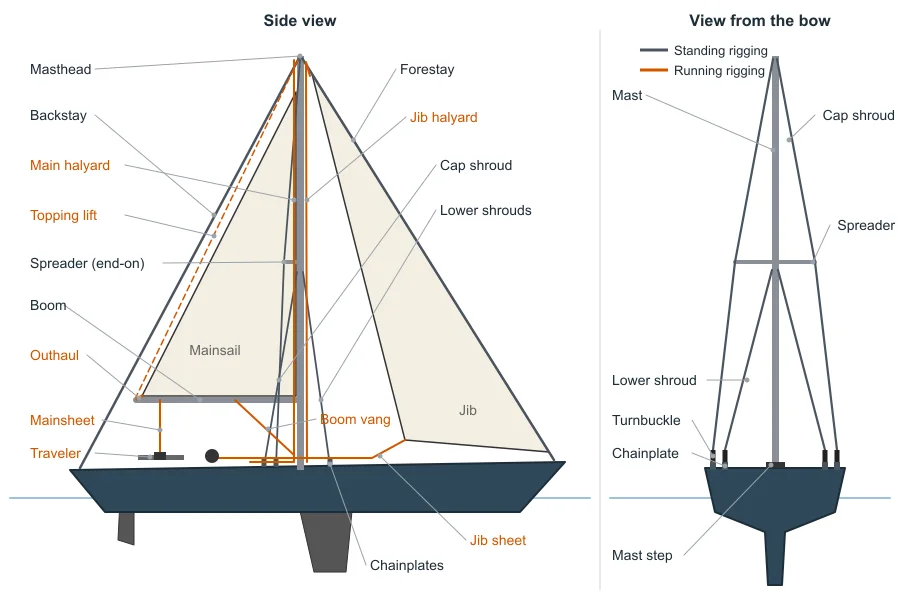
Standing Rigging: What Holds the Mast Up
A mast is a tall, slender column that the sails push on from one side or the other. On its own it would bend and fall over, so wires brace it in every direction. BoatUS Magazine describes standing rigging as the shrouds and stays that keep the mast upright, transferring the forces from the mast and sails to the hull through the chainplates.
Stays: forestay and backstay
Stays support the mast fore and aft. The forestay (also called the headstay) runs from the top of the mast, or a point near it, down to the bow. It stops the mast falling backwards, and on most boats the headsail is hanked onto it or rolled around it on a furler. The backstay runs from the masthead to the stern and stops the top of the mast moving forward.
Many boats have an adjustable backstay, tightened with a block-and-tackle or a hydraulic or screw adjuster. SAIL magazine notes that backstay tension can be changed to affect the rig's tune. On a masthead rig, a mainsail trim guide by Quantum Sails in Cruising World explains, backstay tension also bends the mast, which flattens the mainsail. Some boats add an inner forestay for a smaller headsail, and conventional cutters often need running backstays to support it; our rig types guide explains where those fit.
Shrouds: cap, intermediate and lower
Shrouds support the mast from the sides. On a typical cruising sloop with one set of spreaders there are two kinds on each side:
- Cap shrouds (or upper shrouds) run from the masthead, over the tips of the spreaders, down to the deck. They keep the top of the mast from falling sideways.
- Lower shrouds run from just below the spreaders down to the deck. Many boats have a forward and an aft lower on each side, which also help keep the middle of the mast straight fore and aft.
- Intermediate shrouds appear on masts with two or more sets of spreaders. SAIL describes them as running from the mast at the base of the upper spreaders over the lower spreader tips, then either ending there or continuing down to the chainplates.
The angle between the mast and the cap shroud matters. SAIL notes that this shroud angle is typically never less than 12 degrees. The narrower the angle, the harder the shroud has to pull to hold the mast up, which is why boats use spreaders rather than running the shrouds straight from masthead to deck.
Spreaders
Spreaders are the short struts that stick out from the sides of the mast. In SAIL's words, they hold the shrouds away from the mast. Pushing the cap shroud outward widens its angle, so it can support the mast with less load. Taller rigs have two, three or more sets. SAIL notes that swept-back spreaders are mandatory on modern fractional rigs and are now common on cruising boats with masthead rigs too. Swept-back spreaders also let the shrouds help support the mast fore and aft as well as sideways.
Chainplates
Chainplates are the strong metal straps or fittings, bolted to the hull, a bulkhead or a structural frame, where the shrouds and stays are anchored. Every load the rig carries ends up here, so a chainplate is as important as the wire attached to it. Where a chainplate passes through the deck, the joint has to stay sealed. BoatUS advises checking chainplates above and below deck for cracks, leaks and corrosion, and never painting them, because paint hides corrosion.
Turnbuckles, toggles and terminals
- Terminals are the fittings on each end of a wire that attach it to the mast and to the chainplate. Most are swaged, pressed onto the wire by machine in a rigging shop. SAIL notes that mechanical terminals, which screw together over the wire, are more expensive but reusable and can be fitted by a capable owner.
- Turnbuckles (also called rigging screws or bottlescrews) connect the lower end of each wire to its chainplate. Turning the threaded body shortens or lengthens the stay, which is how a rig is tensioned and tuned. Once set, they are locked with cotter pins or locknuts.
- Toggles are small hinged links between a turnbuckle and the chainplate, or at the masthead. Writing in Good Old Boat, Don Launer explains that toggles correct for misalignment, so the fittings are not bent back and forth as the rig moves, which leads to metal fatigue.
Mast step: keel-stepped or deck-stepped
The foot of the mast stands on a fitting called the mast step. A keel-stepped mast passes through a hole in the deck and stands on the keel or a frame low in the hull. A deck-stepped mast sits on a step on top of the deck, with a compression post or bulkhead underneath carrying the load down to the keel. Both are common. The type matters most when you inspect the boat or unstep the mast, because the places to check for corrosion and water are different.
Standing Rigging Materials
- Stainless steel wire: the usual choice. SAIL calls 1x19 stainless wire (19 strands laid together) the go-to choice for most cruising boats, because it stretches less than more flexible wire constructions.
- Rod: solid stainless steel rod. SAIL notes it is fitted to some higher-end performance boats and larger cruising yachts, and that it has a high strength-to-weight ratio and low windage because smaller diameters can be used.
- Synthetic: stays and shrouds made from high-modulus fibre such as Dyneema. Yachting World reports that replacing wire with Dyneema typically removes around 80% of the weight aloft. It also notes the trade-offs: the fibre slowly elongates under constant load, needs protection from chafe and sharp edges, and is harder to inspect. Its recommendation for most cruising yachts is wire for the main shrouds and forestay, with synthetic for items such as running backstays and removable inner forestays.
Running Rigging: The Lines You Adjust
Running rigging is the rope you handle while sailing. Each line has a working end you pull, ease or cleat, and most are led through blocks to the cockpit or the base of the mast.
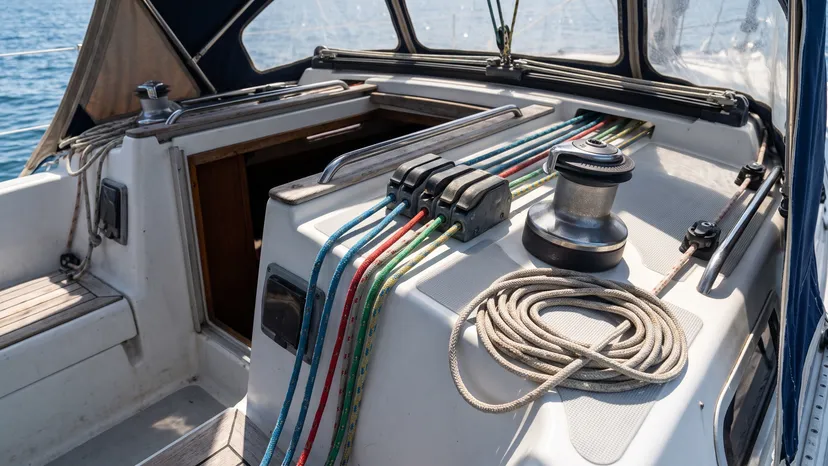
Halyards
A halyard hoists a sail and holds it up. The main halyard runs from the head of the mainsail up to a sheave at the masthead and back down the mast; the jib or genoa halyard does the same for the headsail. Spare halyards are often used for a spinnaker or to hoist a crew member up the mast. Because halyards stay loaded for hours, Cruising World points to them as the place where an upgrade to low-stretch line makes the most difference.
Sheets
Sheets set the angle of a sail to the wind, which is called trimming. The mainsheet runs from the boom through a set of blocks to the cockpit. Headsail sheets come in pairs, one on each side: the one in use is the working sheet and the other is the lazy sheet, ready for the next tack. Each jib sheet usually runs from the clew of the sail through a lead block on a track and back to a winch.
Mainsail controls: traveler, vang, outhaul and cunningham
Several smaller controls shape the mainsail. The same Quantum Sails guide in Cruising World describes what each one does:
- Traveler: a car on a track that the mainsheet attaches to. Moving it to one side or the other changes the boom's angle to the wind, and the guide notes it also helps steer the boat by balancing the helm.
- Boom vang (kicker): a tackle or strut between the boom and the base of the mast. It pulls the boom down and controls twist when the boom is eased out on a reach or run.
- Outhaul: pulls the clew of the mainsail out along the boom. Tightening it flattens the lower third of the sail; easing it adds depth for light air.
- Cunningham: a line that pulls down on the luff of the mainsail, just above the tack, to add luff tension and remove horizontal wrinkles. The halyard does the same job from the top.
A topping lift is a line from the masthead to the end of the boom that holds the boom up when the mainsail is lowered. Boats with a rigid vang, which pushes as well as pulls, often do without one.
Reefing lines and furling line
Reefing lines pull down the luff and leech of the mainsail to reduce its size; our guide on how to reef a mainsail shows how they run. On a roller-furling headsail, the furling line wraps around a drum at the bottom of the forestay. Pulling it rolls the sail up around the stay; easing it while pulling a sheet unrolls it.
Downwind sail lines
Boats that carry a spinnaker add a few more lines: a halyard and sheets for the sail, and on a symmetrical spinnaker a guy (afterguy) on the windward side to control the pole, with a pole topping lift (pole lift) and a downhaul to set the pole's height. Asymmetric spinnakers and gennakers usually need a tack line instead of a pole.
Deck Hardware the Lines Run Through
Running rigging only works with the hardware that guides and holds it:
- Blocks: pulleys that change a line's direction or, combined in a tackle, add mechanical advantage.
- Winches: drums turned with a handle to pull in heavily loaded lines such as sheets and halyards.
- Clutches (rope clutches or jammers): levers that hold a line under load so one winch can serve several lines.
- Cleats: fittings to make a line fast; cam and clam cleats grip a line without tying it.
- Fairleads, cars and tracks: guide a line at the right angle; a car on a track lets you move a sheet's lead fore and aft.
Rope for Running Rigging
According to Cruising World's guide to sailing ropes, polyester double braid is inexpensive, resists UV well and is still a good choice for many jobs on board, though it stretches and is heavier than newer materials. Lines with a core of high-modulus fibre such as Dyneema are lighter and stretch much less, which suits halyards and other lines that stay loaded. The same guide warns that a line must suit the winches and clutches it runs through, because a line that is too thin for the hardware can slip. Nylon is kept for dock and anchor lines, where stretch absorbs shock. For tying it all off, see our guide to sailing knots for cruising and racing.
Checking and Replacing Rigging
Running rigging shows its wear: a fuzzy cover, a flat spot where a line sits in a clutch or a stiff, sun-faded rope. Standing rigging is different, because the damage that matters is often hidden inside a fitting or below deck. BoatUS Magazine calls 10 years the generally accepted service life for wire rigging and recommends an annual professional inspection once the rigging reaches that age. Warning signs it lists include broken wire strands, cracked swage fittings and rust stains.
If you are looking at a used boat, our guide to inspecting an older sailboat covers the rig, chainplates and mast step in detail, and the sailboat maintenance checklist shows when to look at what. Anything structural, such as a cracked fitting, a bent turnbuckle or a weeping chainplate, is a job for a professional rigger.
Frequently Asked Questions
What is the difference between standing and running rigging?
Standing rigging is the fixed wire, stays and shrouds, that holds the mast up and is rarely adjusted. Running rigging is the rope used to hoist, trim and reef the sails, such as halyards and sheets, and it is adjusted constantly while sailing.
Is a halyard standing or running rigging?
A halyard is running rigging. It moves every time a sail is raised or lowered, even though it stays loaded while the sail is up.
What is the difference between a shroud and a stay?
Both are wires that support the mast. Stays support it fore and aft: the forestay runs to the bow and the backstay to the stern. Shrouds support it from the sides and run to chainplates on the port and starboard sides of the boat.
What do spreaders do on a sailboat?
Spreaders push the shrouds out from the mast. That widens the angle between the mast and the shrouds, so the shrouds can support the mast with less load.
How long does sailboat rigging last?
Running rigging is replaced when it shows wear, which depends on use and sun. For stainless steel wire standing rigging, BoatUS Magazine calls 10 years the generally accepted service life, with a professional inspection every year after that. Mileage, climate and how hard the boat is sailed all change the picture, so treat it as a guide, not a deadline.
How do I read a sailboat rigging diagram?
Start with the mast and follow each wire to where it ends. Wires that run to the bow or stern are stays, wires that run to the sides of the boat are shrouds, and anything that leads to the cockpit, a winch or a cleat is running rigging. Many diagrams, like the one above, show the two groups in different colours.
Next Steps
- Walk around your own boat or a club boat with the diagram above and name each wire and line.
- Learn how the mast and sails are arranged on other boats in our guide to sloops, cutters, ketches and other rigs.
- Practise using the reefing lines before you need them.
- Before buying a boat, have the rig inspected, and budget for new standing rigging if its age is unknown.