Sail smarter, float better

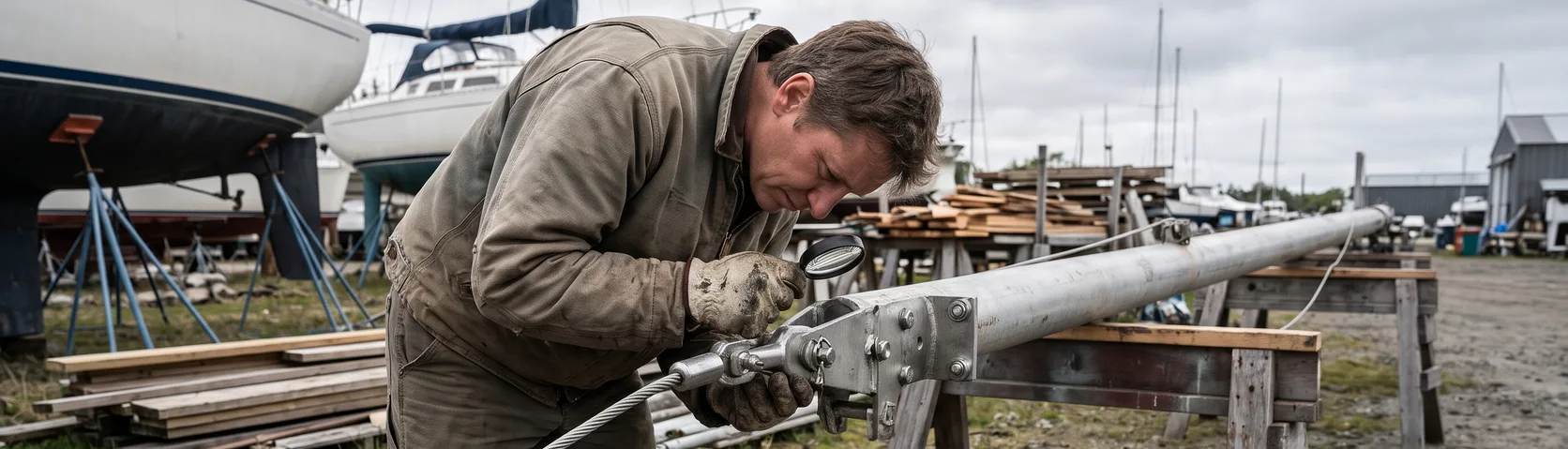
Table of Contents hide
Sooner or later every sailboat owner asks it: the rig looks fine, but it is ten, fifteen or an unknown number of years old, so does it need replacing? A failed shroud or stay can bring the mast down, and a re-rig is one of the bigger maintenance bills on a boat, so the answer matters.
The short answer is that published guidelines for stainless steel wire cluster around 10 to 15 years, but age is only one of three things that decide it. The rigging's condition and your insurer's terms count as much. This guide covers all three, plus the warning signs, what a re-rig includes, materials, DIY and cost. If the names of the parts are new to you, start with our guide to sailboat rigging explained, which labels each one on a diagram.
Key Takeaways
- About 10 to 15 years for wire: BoatUS Magazine calls 10 years the generally accepted service life of wire rigging; a rigger interviewed by Cruising World recommends 10 to 15 years, depending on how hard the boat is sailed.
- Wire rarely warns you: stainless steel wire fails from fatigue, often without visible signs, so age matters even when the rig looks good.
- Some signs mean stop now: broken strands, cracked terminals or turnbuckles, rust weeping from fittings, damaged spreaders or a leaking chainplate need a rigger before the boat goes sailing again.
- A re-rig is more than wire: plan for terminals, turnbuckles, toggles and pins, a furler service and a chainplate check, and usually a haul-out with the mast unstepped.
- Costs are dated and vary: riggers quoted Cruising World about $4,000 to $6,000 or more for a 40-foot boat (2017, updated 2020), and one put hauling and mast stepping at about $2,500 extra; get current, itemised quotes.
How Long Does Standing Rigging Last?
No single figure fits every boat. The table collects what established sources say, with the year each one was published or updated.
| Rigging | Published guideline | Source |
|---|---|---|
| Stainless steel wire | About 10 years is the generally accepted service life; after that, a professional inspection every year until it is replaced | BoatUS Magazine, 2026 |
| Stainless steel wire | Replace every 10 to 15 years: about 10 for offshore bluewater boats, about 12 for serious coastal cruisers (rigger Steve Madden) | Cruising World, 2017, updated 2020 |
| Stainless steel wire | Good-quality rigging can last up to about 20 years if well maintained and problems are fixed promptly | SAIL, 2015 |
| Rod | Navtec's guideline, as reported: inspect thoroughly and re-head after 40,000 miles; a rigger quoted recommends replacing rod over 20 years old | SAIL, 2013 |
| Synthetic (Dyneema/HMPE) | Five to eight years is "probably prudent" for private cruising yachts, although many rigs last up to 10 years or more | Yachting World, 2026 |
The reason age matters so much is fatigue. Every time the boat tacks, pitches or rolls, the load on each wire changes. Cruising World's article explains that stainless steel can only take a finite number of these flex cycles, puts the theoretical life at 10 to 15 years of cycling, and notes that wire rarely gives any warning before it breaks. Boats sailed hard offshore use up those cycles faster, hence the shorter interval riggers suggest for them.
Tuning matters too: Cruising World describes a 46-foot cutter whose new wire stretched, was not re-tuned for several seasons and failed after six years, and rigger Steve Madden names a slack leeward shroud as the main danger. Rod and synthetic rigging age differently from wire. Rod is serviced by mileage or time (Navtec: re-head after 40,000 miles; Cockerill: every five to six years), and its terminals (the "heads") are the weak point: SAIL's answer notes that more than 95 percent of rod failures are head failures. Synthetic rigging is limited mainly by sunlight and internal abrasion, according to Yachting World.
Age, Condition or Insurer: What Decides It
Three separate triggers can tell you it is time, and any one of them is enough.
- Age. Once wire rigging reaches about 10 years, BoatUS recommends a professional inspection every year until it is replaced, and Cruising World's riggers agree that re-rigging should be considered as it approaches 15. If nobody knows the rig's age, treat it as old.
- Condition. Any of the warning signs below means replacement now, whatever the age. Clean, straight wire does not prove the opposite, because fatigue cracks often start inside a terminal where you cannot see them.
- Insurer. SAIL's 2015 guide says most insurance companies reckon standing rigging should be replaced about every 10 years, and that some allow longer if a professional has inspected the rig. Rigger Jay Herman told Cruising World that some insurers require a re-rig when the standing rigging on a used boat is more than 15 years old. Policies differ and change over time, so read your own and ask your insurer or broker. Our sailboat insurance guide lists the questions to ask about the mast and rigging.
Warning Signs That Mean Replace Now
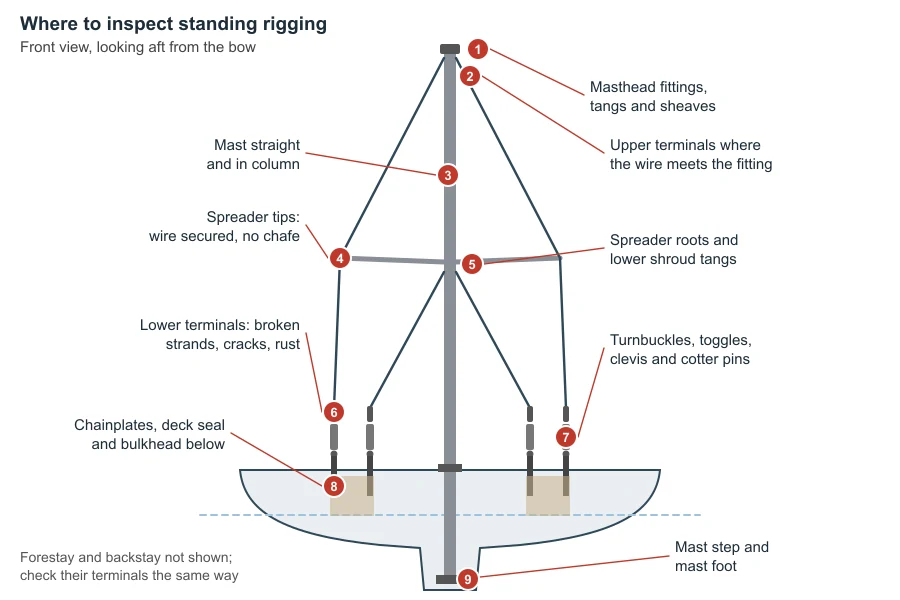
The BoatUS and SAIL inspection guides list the same family of faults. Any of these on a shroud, stay or fitting means the part, and usually its partner on the other side, needs replacing:
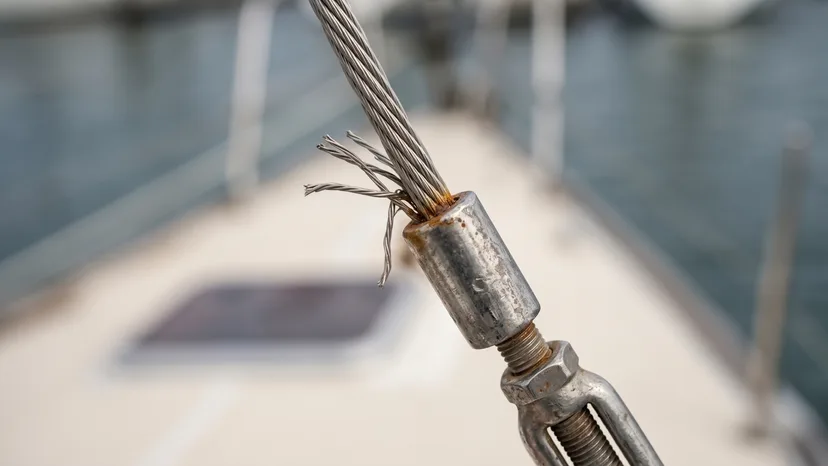
- Broken strands ("fishhooks"), especially where the wire enters the swaged terminal. (BoatUS, SAIL)
- Cracks in terminals, usually running lengthwise along a swage, and fittings that look bent, bulged or misshapen. Hairline cracks are hard to see; Cruising World notes that the machine marks left by swaging can look like cracks, which is one reason to have a rigger check (BoatUS, SAIL, Cruising World).
- Rust on the wire: a dull, pitted or rusted appearance. Cruising World's riggers say light rust streaks on the wire ("candy-striping") may only be surface staining that polishes off, but it needs a closer look (BoatUS, Cruising World).
- Cracked or bent turnbuckles and seized toggles. SAIL links cracked turnbuckles to misalignment and to a rig "pumping" in rough seas; BoatUS also flags turnbuckles with too little thread engaged (BoatUS, SAIL).
- Bent spreaders or damaged spreader roots (SAIL), uneven spreader angles, or a mast that is no longer in column (BoatUS).
- Leaking or corroded chainplates: running rust, failing sealant where the chainplate passes through the deck, or stained, soft wood around it below. SAIL points out that it is often the structure around the chainplate, not the metal, that gives way (BoatUS, SAIL).
If you find a cracked fitting, broken strands, a damaged spreader or a chainplate that is pulling or leaking badly, do not go sailing to see how it holds up. Keep the boat in harbour and call a professional rigger. BoatUS also recommends a rigger's inspection after heavy weather or any known extreme stress on the rig.
Inspecting Before You Decide
Owners can make a useful first check from deck. BoatUS suggests cleaning and inspecting the fittings you can reach, photographing them so you can compare them next season, and checking the mast and spreaders from deck level with binoculars. A magnifying glass and a bright light help with terminals, turnbuckles and chainplates. BoatUS also suggests running a handful of tissue paper up the reachable wire to catch broken strands. Look below deck too, where the chainplates meet the bulkheads or knees.
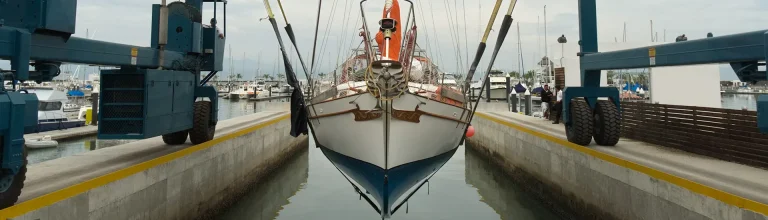
What you cannot judge from deck is the top of the rig and the inside of the fittings. BoatUS says the best inspection is with the mast unstepped in a boatyard; when that is not possible, it recommends having a qualified rigger go aloft. Going up the mast is work for trained people with proper equipment, and a professional will also use dye penetrant to show cracks the eye misses, as SAIL and BoatUS describe.
How often? SAIL recommends a thorough check of the standing rig at least once a season and a look over each part about once a month, or before any cruise of more than a few days. BoatUS recommends an inspection at least once a year, and a professional one every year once the wire is 10 years old. Rigger Jimmie Cockerill told Cruising World he recommends pulling the mast and inspecting wire rigging every five to six years, and that rod needs servicing on the same schedule. Our sailboat maintenance checklist fits these checks into the boat's yearly jobs.
What a Re-Rig Usually Includes
"Replacing the standing rigging" usually means new wire and new end fittings for every stay and shroud at the same time. A typical job covers:
- Wire and terminals: each forestay, backstay, cap shroud and lower shroud, cut to the measured length with new swaged or mechanical terminals at both ends.
- Turnbuckles, toggles and pins: usually renewed with the wire, and cotter pins, split rings and seizing wire always. SAIL's rule for any doubtful part is "if in doubt, sling it out."
- Furler service: the roller furler has to come off the forestay anyway, so SAIL recommends servicing it fully at the same time. BoatUS advises taking furlers apart for inspection at least every 10 years.
- Chainplates: inspected, rebedded with fresh sealant and replaced if they show cracks or corrosion. BoatUS recommends removing chainplates for a full inspection about every 10 years, however they look, and Cruising World's riggers call them a common failure point, especially where they pass through the deck.
- Mast hardware (as needed): tangs, spreader fittings, masthead sheaves and the mast step get checked while the mast is down; replacing them is an extra.
If you replace only part of the rig, SAIL recommends replacing shrouds and stays in pairs, which also keeps both sides of the rig matched. Replacing the forestay is often the moment to unstep the mast, because getting the furler off without damage can be difficult with the mast up (SAIL).
Wire, Rod or Synthetic at Replacement
Most cruising boats use stainless steel wire, and the riggers Cruising World interviewed sum up the usual advice as "run what you brung": replace like with like unless you have a strong reason to change. Switching is rare and can be costly, because the mast fittings may need modifying. Our guide to rigging materials explains the basics of each type.
| Material | Advantages (as sources state them) | Drawbacks |
|---|---|---|
| Stainless wire | Cheaper, easier to handle, and can be repaired far from a rigging shop with mechanical fittings and basic tools (Cruising World) | Fatigue with little warning; corrosion inside fittings |
| Rod | Less stretch, weight and windage, and arguably a longer life (Cruising World) | Ends must be cold-headed in a rigging shop, so no mechanical-fitting repair on the road; regular service by mileage or time |
| Synthetic (Dyneema/HMPE) | About 80 percent lighter aloft than wire; no corrosion, swage cracks or broken strands (Yachting World) | Sensitive to UV, internal abrasion and heat; must be oversized and heat-set to limit creep; splicing needs real expertise; harder to repair in remote places (Yachting World) |
Synthetic rigging is not automatically cheaper. Yachting World notes that the thicker line needed to match a wire's stretch (it gives the example of 12-13 mm HMPE for 8 mm wire) eats into the price difference, and that labour can be 20 to 40 percent higher than for wire unless the splicer is very experienced. A change of material is a decision to make with a rigger who knows your mast.
DIY or Professional Rigger
Owners do replace their own standing rigging, but the job has limits.
- Terminals decide a lot. Swaged terminals are pressed on by a machine and are strong and long-lived, but swaging has to be done by a rigger. Mechanical terminals such as Sta-Lok, Norseman or Hi-MOD can be fitted with hand tools and opened up for inspection; Cruising World quotes a rigger saying the newer Hi-MOD fittings cost about twice as much as a swaged one. A common compromise, described by both SAIL and Cruising World, is swaged terminals at the top and mechanical ones at deck level, where corrosion is more likely and inspection is easier.
- Measuring matters. SAIL advises photographing every fitting before it comes off, measuring each wire between pin centres under tension, and leaving at least a third of the turnbuckle's thread free for adjustment.
- Mast up or down. Replacing shrouds with the mast up is possible but needs the mast supported with halyards and tackles while each wire is off, and the forestay and backstay carry the highest loads. Unstepping the mast at a yard is safer and lets the top of the rig be inspected properly.
- Tuning afterwards. New wire stretches at first, and as the 46-foot cutter in Cruising World's example shows, a rig that is not re-tuned can fail early. SAIL describes tuning from the bottom up with equal turns on each side and says low-cost tension gauges help; if you are unsure, have a rigger tune the new rig and check it again after the first sails.
How much does doing it yourself save? Rigger Jimmie Cockerill estimated for Cruising World that an owner doing the labour on a 40-foot boat could save as much as $2,000 in labour. Steve Madden noted that many of his clients prefer a professional for this job, because it removes unknowns before going offshore. If you are not confident with measuring, fittings and tuning, pay the rigger.
What Standing Rigging Replacement Costs
Editorial price figures are scarce and date quickly. The best-documented ones come from Annapolis riggers interviewed by Cruising World in an article first published in 2017 and updated in 2020:
| Example (40-foot boat, wire) | Figure quoted | Who said it |
|---|---|---|
| Rule of thumb for wire re-rigging | About $100 per foot, about $4,000 for a 40-footer | Jimmie Cockerill, The Rigging Company |
| Hauling, launching and stepping the mast | About $2,500 on top | Jimmie Cockerill |
| Re-rig estimate | About $4,600 | Steve Madden, M Yacht Services |
| Professionally done re-rig | Closer to $6,000 or more, depending on furler, fittings and chainplates | Steve Madden |
Treat these as a 2017-2020 starting point, not today's price. Prices have changed since and vary by region. Madden also points out that cost does not rise in a straight line with boat length, because bigger boats need heavier wire and larger fittings. The main things that move the price are:
- boat size and the number of stays and shrouds (an extra forestay, intermediates or running backstays all add wire and fittings);
- wire, rod or synthetic, and swaged or mechanical terminals;
- whether turnbuckles, toggles and mast tangs are replaced or reused;
- furler service or replacement;
- chainplate removal, rebedding or replacement, and any repair to the deck or bulkheads around them;
- crane time, haul-out, storage and unstepping and restepping the mast;
- a rigger's travel time if the boat is not at their yard.
Ask two or three riggers for an itemised quote that lists every wire, terminal, turnbuckle and labour item separately, so you can compare like with like and see what has been left out. If you are buying a used boat, the age of the rig belongs in your offer and budget; our guide to inspecting an older sailboat explains what else tends to need replacing at the same age.
Frequently Asked Questions
How often should standing rigging be replaced?
Published guidelines for stainless steel wire range from about 10 years (BoatUS Magazine) to 10 to 15 years (a rigger interviewed by Cruising World), with SAIL noting that well-maintained rigging can last up to about 20 years. Boats sailed offshore need it sooner.
Can I replace standing rigging myself?
Yes, if you are mechanically confident, but with limits. Swaged terminals must be made by a rigger, so a full DIY job means mechanical terminals, careful measuring and proper support for the mast if it stays up. One rigger put the labour saving on a 40-foot boat at up to about $2,000.
How much does it cost to re-rig a sailboat?
Riggers quoted by Cruising World (2017, updated 2020) put a wire re-rig for a 40-foot boat at about $100 per foot, roughly $4,000 to $4,600, and a professionally done re-rig closer to $6,000 or more. Hauling and stepping the mast added about $2,500. Get current quotes.
Does insurance require rigging replacement?
It depends on the insurer. SAIL reported in 2015 that most insurers expect standing rigging to be replaced about every 10 years, though some accept a professional inspection instead, and a rigger told Cruising World that some insurers require a re-rig on used boats with rigging over 15 years old. Check your own policy and ask your insurer or broker.
How long does rod rigging last?
Rod is serviced by mileage or time rather than simply replaced at a fixed age. A rigger told Cruising World rod should be serviced every five to six years, and SAIL reported Navtec's guideline to inspect rod thoroughly and re-head it after 40,000 miles, and quoted a rigger who recommends replacing rod over 20 years old.
Can I replace only one shroud?
You can replace a single damaged shroud, but SAIL recommends replacing shrouds and stays in pairs. If one wire failed from age, have the whole rig inspected.
Next Steps
- Find out how old your standing rigging is from receipts or the previous owner; if nobody knows, assume it is old.
- Do a deck-level inspection with a magnifier and binoculars, and photograph each terminal, turnbuckle and chainplate.
- Check your insurance policy for rules on rigging age.
- If the rig is near 10 years old or shows any warning sign, book a rigger's inspection, ideally with the mast unstepped.
- Get two or three itemised quotes and plan the job around a haul-out, with the furler service and chainplate check included.