Sail smarter, float better

You are about to buy a sailboat, or you already own one, and you need to know what sailboat insurance actually does and what it should cost you. A sailboat policy is a contract that normally has two halves: hull cover, which pays for damage to the boat itself, and liability cover, which pays when you injure someone or damage their property. In the US the requirement to insure usually comes from lenders, marinas and, in some places, state rules rather than from a general national law, and the price depends on the boat, its value, how you use it and where you sail.
This guide is written for buyers and owners in the United States; terms differ in other countries. It explains who asks for insurance, what a policy covers, the difference between agreed value and actual cash value, the policy terms that matter on a sailboat, what moves the price, and how to get and compare quotes. Every insurer page quoted below was read in November 2026. Insurer names appear only as examples of how one policy is written, not as recommendations, and terms change, so check current terms with the insurer before you rely on anything here.
Key Takeaways
- Hull and liability are the core: hull cover repairs or replaces the boat, liability cover pays for harm you cause to others, and the other items (medical payments, towing, personal effects) are add-ons or smaller parts of the package.
- Required or not, you will probably be asked for it: there is no federal requirement, but a lender, a marina slip agreement or a state rule (Hawaii, Arkansas and Utah have one) can set a minimum, and a homeowners policy gives only limited cover for small boats.
- Agreed value vs actual cash value is the biggest wording difference: agreed value pays a figure set when the policy starts on a total loss; actual cash value pays the boat's market value at the time of loss, after depreciation.
- Navigation limits and storm terms matter more on a sailboat than on a runabout: check where you may sail, what happens in a named storm, and how the policy treats the mast, sails and rigging.
- Only a quote for your boat gives a real price: published ranges are examples and vary widely with the boat, its age, your experience and where it is kept.
Do You Need Insurance for a Sailboat?
In the US, the requirement to insure a recreational sailboat comes mostly from the people you deal with and from a few states, not from federal rules. The US Coast Guard's A Boater's Guide to the Federal Requirements for Recreational Boats (revised November 2023), which sets out the federal registration, documentation, equipment and safety rules for recreational boats, contains no insurance requirement. Other parties can require it:
- Lenders. A lender that takes the boat as collateral wants it insured before it funds the loan; the sailboat financing guide covers what lenders ask for.
- Marinas and yacht clubs. The BoatUS boat insurance FAQ says a slip or storage agreement may set a minimum liability limit. Practical Sailor, in a May 2026 article, says most marinas and foreign ports now expect $500,000 to $1 million in minimum liability limits. Read your slip agreement; the figure is the marina's, not the insurer's.
- States. Most states do not require boat insurance, but a few do, and the rules are narrow:
- Hawaii: the Hawaii Division of Boating and Ocean Recreation states (page last updated March 2022) that boats 26 feet and longer must carry at least $100,000 of coverage that includes removal and salvage of a grounded vessel (smaller boats too if the owner has grounded a vessel in Hawaii before). This is the rule most likely to catch a cruising sailboat.
- Arkansas: the state's boating handbook, published with the Arkansas Game and Fish Commission (2026 edition), says all motorboats with engines of more than 50 horsepower and all personal watercraft must carry liability insurance of at least $50,000 per occurrence.
- Utah: the Utah boating study guide says motorboats and personal watercraft operated on Utah waters must carry owner's or operator's liability insurance; motorboats with engines under 50 horsepower are exempt, and non-resident owners on Utah waters for less than 90 days are exempt unless their home state also requires insurance. A 2026 bill to repeal the requirement (H.B. 169) did not pass, according to the state's 2026 boating legislative summary.
What a Homeowners Policy Does and Does Not Cover
The Insurance Information Institute (Triple-I) says in its boat insurance and safety guide (read November 2026) that most insurers give limited property-damage cover for small boats under a homeowners or renters policy, generally for the boat, motor and trailer combined, and that liability is usually not included unless added by endorsement. Larger boats need their own policy. Whether a particular sailboat is covered depends on its size, its engine and your insurer, so ask your agent in writing before you assume a homeowners policy applies.
Why Liability Matters Even When Nobody Requires It
If your boat injures a swimmer, damages a neighbour's yacht or sinks at its mooring and has to be removed, the costs fall on you. Liability cover is what pays them. The BoatUS FAQ says liability limits are commonly offered at $100,000, $300,000, $500,000 and in some cases $1,000,000, and that you should choose a limit that fits your needs if you also have an umbrella policy.
What a Sailboat Policy Covers
Practical Sailor's December 2024 article lists six basic coverages: hull, liability, personal property, medical payments, uninsured boater, and towing and assistance. Triple-I's guide describes hull, liability, medical payments, towing, and optional trailer and accessories cover in similar terms. Policies bundle and word these differently, so treat the table as a checklist of questions rather than a promise of what you will get.
| Cover | What it pays for | Questions to ask |
|---|---|---|
| Hull (physical damage) | Loss of or damage to the boat, its machinery and fittings (Triple-I) | Agreed value or actual cash value? Are sails, rigging and the engine treated differently? |
| Liability | Bodily injury to others and damage to their property (Triple-I) | What is the limit? Does the marina or the countries you visit expect more? |
| Medical payments | Injuries to you and your passengers (Triple-I) | What is the limit? It does not replace health insurance, as Practical Sailor notes. |
| Uninsured boater | Losses when an uninsured party causes the accident (listed by Practical Sailor) | Is it included, and at what limit? |
| Personal property | Personal effects and gear aboard (Practical Sailor lists personal property among the basic coverages) | Is there a sub-limit? Are electronics and the dinghy covered, and at what deductible? |
| Towing and assistance | On-water towing and assistance (Triple-I and Practical Sailor list towing among the coverages) | Is it in the policy or a separate membership? Practical Sailor's May 2026 article says a BoatUS or Sea Tow membership is often better value than excess towing cover. |
| Salvage and wreck removal | Raising or removing a sunk or grounded boat, which some rules require (see Hawaii above) | Is salvage inside the hull limit or a separate limit? Practical Sailor calls this one of the most consequential policy differences. |
| Trailer | Trailer and accessories (Triple-I lists trailer or accessory coverage) | Only relevant if you trail the boat. |
Ask whether pollution and fuel-spill liability is included and at what limit; Hawaii's rules for boats in state harbours, for example, require salvage, pollution and dock-damage cover in the liability policy.
Agreed Value vs Actual Cash Value
These two terms decide how much you are paid when the boat is lost.
- Agreed value (also called agreed hull value or agreed amount): you and the insurer settle a value when the policy starts. On a total loss you receive that amount. The BoatUS agreed hull value page says the policy pays up to the value agreed when you start the policy, and Triple-I says partial losses are replaced with new items without a depreciation deduction (subject to the policy's own depreciation clauses, below).
- Actual cash value (ACV): the insurer pays the boat's value at the time of the loss. Triple-I describes ACV as paying replacement cost less depreciation, so a partial-loss repair is reduced by depreciation and a total loss is valued with used-boat pricing guides. The BoatUS ACV page describes it as the boat's current market value, not the replacement value, and says it offers a lower annual premium for boaters who need less coverage.
Depreciation also shows up inside agreed value policies. The BoatUS agreed hull value page says that on partial losses, for sails, canvas, carpeting, cushions and fabric, and for outboards, outdrives, propulsion machinery and generators, it will pay no more than actual cash value, with at least 20% residual value regardless of age. On a sailboat, where sails, canvas and gear are a large part of the value, read the depreciation schedule in the policy.
Markel's yacht page (read November 2026) offers agreed value on a total loss and describes choosing ACV as reducing your coverage to reflect depreciation; its page covers vessels over 26 feet. Practical Sailor's May 2026 liveaboard article says that cruising boats generally need agreed value rather than ACV. The BoatUS ACV page markets that option for runabouts, ski boats and personal watercraft, which is a different kind of boat from a sailboat that has been refitted over the years. If you are buying with a loan, ask your lender what it accepts.
Policy Terms That Matter for Sailboats
Beyond the headline price, these terms decide whether a claim is paid. Each one is a question to put to the insurer and to check in the policy wording, not in the sales page.
Navigation Limits and Cruising Area
Navigation limits define where you may use the boat. Practical Sailor's May 2026 article lists seasonal hurricane boundaries, geographic exclusions (it names Venezuela and parts of Central America) and offshore distance caps, and says offshore caps can range from 150 to 250 miles. Travelers' representative, quoted in the December 2024 Practical Sailor article, advises having the appropriate navigational limits on the policy for where you use the boat. BoatUS says in its FAQ that cruising in Mexico needs a cruising extension covering physical damage only, and that Mexican law requires liability insurance from a Mexican insurer. Ask for your intended route in writing, including any offshore passages or any foreign cruising.
Named Storms and Hurricane Haul-Out
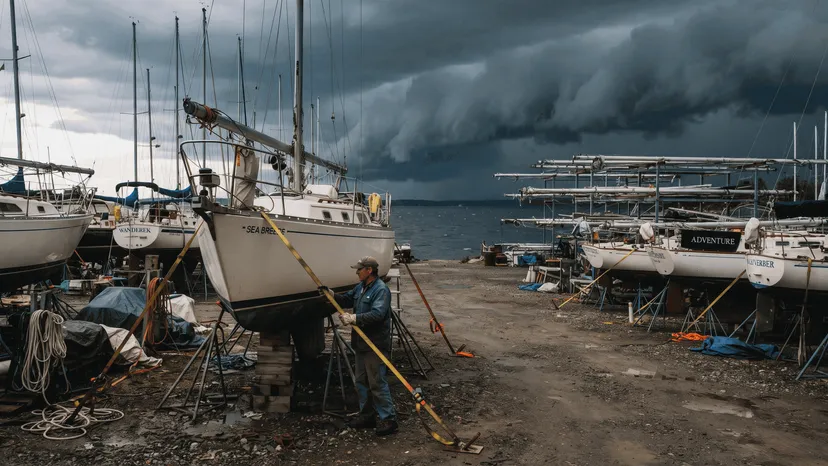
If you keep a boat in a hurricane zone, ask how the policy treats named storms: whether there is a separate deductible for named-storm damage, whether the policy expects a hurricane plan (hauling out or moving the boat), and whether you can buy or change cover once a storm is forecast. Some policies share the cost of protecting the boat. The BoatUS claims information page says that all its policies receive named-storm haul-out reimbursement of 50% of the cost, up to $1,000 per event, for a professional move, haul-out or hurricane plan before a NOAA named storm. Markel's yacht page lists a named-storm extra-expense feature in which it shares the expense of protecting the yacht before landfall. These are examples from one provider each, as of November 2026; benefits and triggers vary, so check current terms.
Mast, Rigging and Racing
Ask whether the mast and rigging are covered for sudden damage and what the policy treats as wear. Practical Sailor's "Boat Insurance: Reading the Fine Print" (published 2001, updated 2019) says normal wear and tear, osmosis and delamination, and failure to maintain the boat are typically excluded across the policy, not only for the rig. The same article (last updated 2019) says most policies then covered sailboat racing, but terms have changed since; if you race, tell the insurer and ask whether the mast, rigging and sails are covered while racing. BoatUS lists racing among the uses that affect the premium.
Lay-Up, Crew and Single-Handing
Some policies set periods when the boat must be out of the water or inactive, or conditions on crew and sailing alone. Terms vary by insurer, so ask each one directly if you winterise the boat, sail short-handed or take on paid or unpaid crew.
Charter
Using the boat for paid charter is a different risk. BoatUS lists commercial charter among the uses that change the premium, and Markel's yacht page (read November 2026) says optional limited charter cover is available if the captain has a minimum of two years of loss-free experience, with additional restrictions possible. If you charter even occasionally, disclose it.
What Affects the Cost
The BoatUS FAQ lists these inputs to its price: coverage amount, location, use, size, age, power type, and the owner's experience and claims record; it also lists the type of boat, the number of engines and horsepower, where the boat is stored, a completed boating safety course, and insuring multiple boats with one company. It gives no dollar figures. Triple-I names the size, type and value of the craft and the water where it is used, and says discounts may be available for diesel engines, Coast Guard-approved fire extinguishers, ship-to-shore radios, completed boating safety courses, multiple policies with one insurer and two claims-free years. The sailing safety equipment list covers the gear that may earn some of these discounts.
For a sailboat in practice, the factors that usually push the price up or down are:
- Value of the boat and the amount you insure it for.
- Age, size and condition, including the age of the rigging and engine.
- Where it is kept and sailed, especially in hurricane-exposed areas.
- How you use it: weekend sailing, liveaboard, offshore, racing or charter.
- Your experience, courses and claims history.
- Deductible and liability limit: the BoatUS FAQ says a higher deductible and a lower liability limit reduce the premium.
Cost Figures: One Dated Example
Published prices vary widely and are rarely based on a single boat. One recent example: Practical Sailor's May 2026 liveaboard article, written by a marine insurance broker who sells this kind of cover, gives his own general estimates (not carrier quotes and not sourced to market data) of about 2% to 3.5% of hull value per year for a 35-45 ft monohull in cruising or liveaboard use, with 25% to 75% added for bluewater or hurricane exposure, and about $2,000 to $4,000 a year for a well-maintained 40-ft US cruising sailboat under standard conditions. It also says liveaboard policies typically cost 20% to 40% more than comparable recreational policies. Premiums vary with the boat's make and model, its value and its condition, so treat these as a sanity check for a cruising boat at one point in time, not as a rule for your boat. The only real number is a quote for your boat, with your use and your cruising area.
Insuring an Older Sailboat
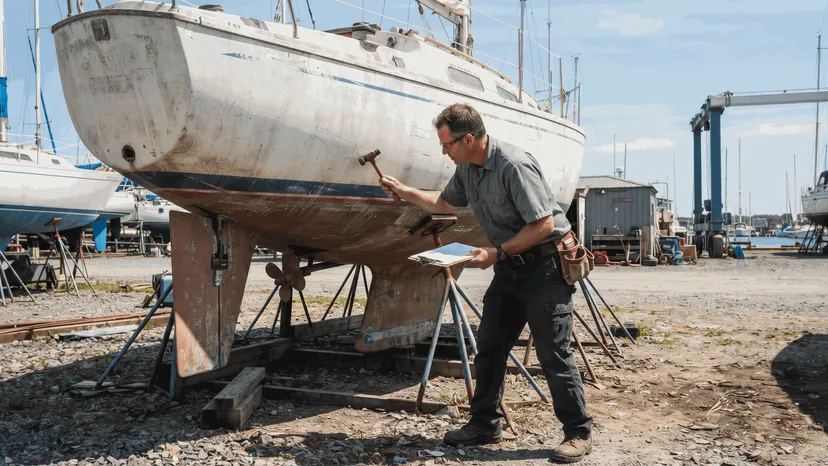
An older boat can usually be insured, but it takes more preparation and the choice of insurers narrows. Practical Sailor's December 2024 article reports from an informal survey that the tipping point seems to be 40-plus years for most companies and as low as 15 years for some, and that a failed first application does not mean insurance is unavailable. It also says policies are generally based on a survey by an insurer-approved surveyor at the time of purchase, that some companies require surveys at intervals, and that stricter policies require a rig inspection on top of the survey. Practical Sailor's May 2026 article adds that most markets require a survey within 3 to 5 years and documentation of refits.
Before you ask for a quote on an older boat:
- Get a recent survey and ask the insurer which surveyors and report ages it accepts; see when insurers require a survey.
- Gather proof of refits and replacements: rigging, wiring, plumbing, engine, hoses and seacocks.
- Know the age of the standing rigging; the older sailboat safety inspection guide explains what ages first and what insurers tend to ask about it.
- Ask whether agreed value is offered on a boat of that age, or whether the policy would be ACV only, and what that means for a total loss.
- Use a broker: Practical Sailor says underwriters set the criteria and a broker can find one whose policy fits the boat.
Liveaboard and Offshore Cruising Cover
Living aboard changes the risk, so tell your insurer. Markel's yacht page says it provides liveaboard coverage and asks you to disclose that you live aboard to your agent. Practical Sailor's May 2026 article says the market for full-time cruising and liveaboard risks has not eased: fewer carriers write full-time offshore risks, standard carriers often decline older boats, boats without current surveys and full-time liveaboards, and those risks often move to specialty markets. It says direct carriers generally restrict navigation, decline older vessels and are not set up for full-time liveaboard risks, so a broker is the usual route, and it suggests starting renewal 60 to 90 days before expiry.
For offshore and foreign waters, check three things: the navigation limits (cap in miles and areas excluded), the liability limit that marinas and ports expect, and whether the policy has any crew conditions for passages. Medical payments cover on a boat policy is not a replacement for health or travel insurance; Practical Sailor says inflated medical payment limits do not replace health insurance, so arrange that separately. The cost of living on a sailboat guide shows where insurance sits in a liveaboard budget.
How to Get a Quote and Compare Policies
An insurer or broker typically asks for the boat's make, model, year, length, value, engine and equipment, a recent survey on older or larger boats, your sailing experience, where the boat is moored and where you plan to sail, and how you will use it. BoatUS says in its FAQ that it gives a firm quote rather than a ballpark figure and does not require membership for a quote. Some insurers write directly, some work only through brokers, and some are offered through clubs or associations; for an unusual or older boat, Practical Sailor's articles suggest a broker can find an underwriter whose criteria fit.
Compare quotes on the same terms. A checklist:
- Is hull cover agreed value or actual cash value, and how are sails, canvas and the engine depreciated?
- What are the deductibles, including any separate named-storm deductible?
- What are the navigation limits, in miles and in named areas?
- What is the liability limit, and does it meet your marina's or lender's minimum?
- Is salvage and wreck removal inside the hull limit or separate?
- How are the mast, rigging and racing treated, and what counts as wear?
- What are the lay-up, crew and single-handing conditions?
- Which towing and personal property limits apply?
- What exclusions apply to your use (liveaboard, charter, offshore)?
- What survey and rigging conditions must you meet to bind and to renew?
Answer every question honestly. Policies are priced on what you tell the insurer, and a claim can be disputed if you did not disclose how you use the boat. Get the policy wording, not just the quote summary, and read the exclusions before you pay.
Frequently Asked Questions
How much does sailboat insurance cost?
It depends on the boat, its value, your use and your area, and there is no single reliable figure for all sailboats. One dated example is a broker's estimate published by Practical Sailor in May 2026, roughly $2,000 to $4,000 a year for a well-maintained 40-ft US cruising sailboat. Premiums vary with the boat's make and model, its value and its condition, as well as with your use and cruising area, so a quote for your boat is the only real price.
Is sailboat insurance required?
Not under federal rules: the US Coast Guard's guide to the federal requirements for recreational boats contains no insurance requirement. A lender, a marina or yacht club may require it, and so do a few states: Hawaii for boats 26 feet and longer, and Arkansas and Utah for motorboats with larger engines (over 50 horsepower in Arkansas, 50 horsepower or more in Utah). Check your loan terms, slip agreement and state.
Does homeowners insurance cover a sailboat?
Triple-I says most insurers give limited cover for small boats under a homeowners policy, usually for boat, motor and trailer together and often without liability unless added. Larger boats need their own policy. Ask your agent for the exact terms.
Can you insure a 40-year-old sailboat?
Often yes, but fewer insurers will write it. Practical Sailor (December 2024) says 40-plus years is the tipping point for most companies, a failed first application does not mean no cover is available, and a recent survey, documented refits and a broker help.
Does boat insurance cover hurricanes?
Some policies cover storm damage, but terms vary. Ask about the named-storm deductible, hurricane navigation boundaries and any haul-out benefit; one provider's example is BoatUS's reimbursement of 50% of the cost, up to $1,000 per event, as of November 2026.
Next Steps
Decide how you will use the boat and where you will keep it, then get at least two written quotes on the same terms, ideally before you make an offer. Ask for the policy wording, read the navigation, named-storm and exclusion clauses, and tell the insurer how you really use the boat. If you are financing, confirm what your lender requires before you commit; if the boat is older, line up a survey and rigging details first.