Sail smarter, float better

Table of Contents hide
You are buying a sailboat, or you already own one, and you keep hearing that you can "register" it with the state or "document" it with the Coast Guard. They are two different systems. Boat documentation is a federal form of registration issued by the US Coast Guard's National Vessel Documentation Center (NVDC). State registration, also called numbering, is run by the state where the boat is mainly used. Most recreational boats only need state registration. Documentation is optional for a recreational boat that measures at least five net tons and is wholly owned by US citizens, and a documented boat may still have to be registered with the state.
This guide is for owners and buyers in the United States. It compares the two systems, explains who can document a boat, why owners do it, what changes at the state level, how the markings differ, and what to check when you buy a boat that is already documented. Every fee, term and legal point below carries its source and was read on 3 November 2026; rules and fees change, so confirm current details with the NVDC and your state boating agency before you file anything. This is general information, not legal advice.
Key Takeaways
- Two systems, two issuers: the Coast Guard issues a Certificate of Documentation; your state issues a registration (certificate of number) for a boat with an engine, and some states require registration of other boats too.
- Documentation is optional for most sailors: a recreational boat must measure at least five net tons (a measure of volume, not weight) and be wholly owned by US citizens to qualify.
- Documentation does not replace state rules: the Coast Guard's own boater's guide says a documented boat is not exempt from state or federal taxes or equipment rules and may still owe a state registration fee and display a state sticker.
- Documentation is the usual route to a preferred ship's mortgage and gives a federal record of title, which matters for financing and resale.
- Use the official NVDC site: companies exist that charge extra to file the same paperwork, and the Coast Guard says they do not act for it.
What Is the Difference?
The table compares the two systems for a recreational sailboat. State rules differ, so the state column describes the federal framework and what states may add.
| Aspect | USCG documentation | State registration (numbering) |
|---|---|---|
| Who issues it | The NVDC, a US Coast Guard unit (46 CFR part 67) | The state of principal operation, under a system approved by the Coast Guard (46 U.S.C. 12302) |
| Who is eligible | A vessel of at least five net tons wholly owned by US citizens (46 CFR 67.5) | An undocumented vessel with propulsion machinery must be numbered (46 U.S.C. 12301); states may require more |
| Optional or required | Optional for a recreational vessel; required for vessels engaged in fisheries or coastwise trade of five net tons or more (46 CFR 67.7, 67.9) | Required for an engine-equipped undocumented boat; some states also require registration of boats without motors and of documented boats (USCG Boater's Guide, November 2023) |
| What it shows | A national form of registration and evidence of the vessel's nationality for international purposes (USCG Boater's Guide) | That the boat is numbered in a state; the number must be displayed (33 CFR 173.15) |
| Where it is recognised | Nationally, and as evidence of nationality abroad (USCG Boater's Guide) | In the issuing state, and in other states for temporary use or for 60 days after a move (46 U.S.C. 12302) |
| How long it lasts | A recreational endorsement can be issued or renewed for 1, 2, 3, 4 or 5 years (46 CFR 67.163) | Federal law caps a certificate of number at three years (46 U.S.C. 12304); each state sets its own term |
| Cost | Federal fees set in 46 CFR 67.550 (see below) | Set by each state, which may charge fees (46 U.S.C. 12307) |
| Markings on the boat | Name and hailing port on the hull, plus an official number inside the hull (46 CFR 67.121, 67.123) | Registration number on the forward half and a validation decal (USCG Boater's Guide) |
| Title and liens | Federal record of ownership; mortgages and bills of sale are filed with the Coast Guard (46 U.S.C. 31321) | Depends on the state; Washington, for example, issues no title for a documented boat (Washington DOL) |
Who Can Document a Boat?
Three conditions come from the statute and regulation: at least five net tons, ownership by US citizens, and a vessel that is not documented under another country's laws (46 U.S.C. 12103; 46 CFR 67.5, 67.30). A recreational endorsement is open to any vessel that qualifies this way (46 CFR 67.23(b)).
Five Net Tons Is Volume, Not Weight or Length
Net tonnage is a measure of a vessel's volume, as the USCG Boater's Guide puts it. The Guide adds that most vessels more than 25 feet long measure five net tons or more. That is a rule of thumb, not a guarantee: the result depends on the hull's dimensions. Under the Coast Guard's simplified measurement rule (46 CFR 69.209), the gross tonnage of a vessel designed for sailing is half of overall length times overall breadth times overall depth, divided by 100, and only 75 percent of the depth is used where the depth includes the keel. Net tonnage is 90 percent of gross for a sailing vessel with propelling machinery in its hull; with no engine in the hull, net equals gross.
To show how much the shape matters, here is the arithmetic for two invented boats, not real measurements. Assuming each depth includes the keel, a boat 30 feet long, 10 feet wide and 5 feet deep with an inboard engine gives 0.5 x 30 x 10 x (5 x 0.75) / 100 = 5.6 gross tons and about 5.1 net tons. A boat 28 feet long, 9.5 feet wide and 4.5 feet deep gives about 4.5 gross and 4.0 net tons, which is under the limit. The NVDC determines tonnage as part of the documentation process for vessels measured this way (46 CFR 67.107), so check with it if your boat is close to the line.
Who Counts as a US Citizen Owner
The vessel must be wholly owned by one or more eligible owners (46 U.S.C. 12103). In 46 CFR part 67, subpart C:
- Individuals qualify if native-born, naturalized or otherwise US citizens (67.33). Joint owners must each qualify, since the vessel must be wholly owned by citizens.
- Corporations qualify for a recreational endorsement if incorporated in the US or a state, with a chief executive and a board chair who are citizens and no more non-citizen directors than a minority of a quorum (67.39).
- Partnerships need citizen general partners and, for a recreational endorsement, at least 50 percent of the equity owned by citizens (67.35).
- Trusts need citizen trustees and citizen beneficiaries with an enforceable interest (67.36); associations and joint ventures need every member to be a citizen (67.37).
The statute also lists an association, trust, joint venture or other entity whose members are all US citizens and that can hold title to a vessel (46 U.S.C. 12103). The regulation does not name limited liability companies, so if your boat is held by one, ask the NVDC how these rules apply before you apply.
Identification and the Recreational Endorsement
The NVDC asks recreational owners applying for initial documentation to check that the boat's Hull Identification Number (HIN) is formatted as 33 CFR 181.25 requires, to avoid processing delays (NVDC website, notice read 3 November 2026). A recreational endorsement entitles the vessel to pleasure use only; the regulation's note says a boat with only a recreational endorsement may be bareboat chartered only for recreational use and points owners to private legal counsel for the elements of a valid bareboat charter (46 CFR 67.23). Other uses need other endorsements and have their own rules, so take chartering questions to the NVDC and a maritime attorney.
Why Owners Document a Sailboat
- Financing. A preferred ship's mortgage is tied to documentation: the statute covers a documented vessel or one with a documentation application filed, with a separate, narrower route for boats titled in a state whose titling system is certified (46 U.S.C. 31322). The Coast Guard's boater's guide notes that vessel financing has been enhanced since 1920 by this availability. Whether a given lender wants a documented boat depends on the lender, so ask before you decide; the sailboat financing guide covers what lenders ask for.
- A federal record of title. Bills of sale and mortgages on a documented vessel are filed with the Coast Guard, and an instrument filed in substantial compliance is valid against other parties from the time it is filed (46 U.S.C. 31321). That gives a buyer one federal place to look; see the used-boat section below.
- International use. The Coast Guard's guide describes the Certificate of Documentation as evidence of a vessel's nationality for international purposes, and the Washington DOL gives "firm evidence of nationality for international travel" as a benefit. What a particular country asks of arriving yachts varies, so check each destination.
What documentation does not do: the Boater's Guide says a documented vessel is not exempt from applicable state or federal taxes or from state or federal equipment carriage requirements, and that it may still be required to pay a state registration fee and display a state validation sticker. Insurance is separate too; see the insurance guide's section on who requires cover.
Do Documented Boats Still Need State Registration?
The federal numbering rules do not apply to a vessel that has or must have a valid marine document (33 CFR 173.11(e)), and a state or Coast Guard certificate of number becomes invalid once the vessel is documented; the owner must remove the number and validation sticker (33 CFR 173.77, 173.33). That is the federal side only. States set their own registration rules, and the Boater's Guide warns that some states require all vessels to be registered, including documented ones. Two dated examples of how differently it can read:
- Washington: the Department of Licensing page for documented boats (no revision date shown, read 3 November 2026) says that unless specifically exempt, you must meet all Washington registration requirements when using a documented boat on Washington waters, with 60 days to register after moving there and 15 days if you buy the boat in another state. You submit the Certificate of Documentation and a Vessel Title Application and pay the fees, but the state issues no title for a documented boat.
- Texas: the Texas Water Safety Act publication (September 2025 to August 2027 edition) says documented vessels must display the registration validation sticker on both sides of the bow, or display the state-assigned numbering series with the decal, and it sets out what a documented-boat owner presents at registration, including the Coast Guard documentation or the application for it. Vessels over 115 feet are exempt. The federal rule that removes a federally issued number on documentation does not stop a state from setting its own display rule for documented boats, so follow your state's rule.
These are examples, not a state list. Some states may treat a documented boat differently again, and rules change. Check the registration page of the agency in the state where you keep the boat, and ask it directly about any state tax, the decal and what it needs to see from the NVDC. The sailing safety equipment list also covers state equipment rules that apply whether or not a boat is documented.
Markings
The markings differ because the two systems identify the boat differently.
- Documented boat, outside: the vessel name and hailing port must be marked together on a clearly visible exterior part of the hull of a boat documented exclusively for recreation, in clear letters at least four inches high (46 CFR 67.123; USCG Boater's Guide). The hailing port must be a US place that includes the state, territory or possession (46 CFR 67.119).
- Documented boat, inside: the official number, preceded by "NO.", in block numerals at least three inches high on a clearly visible interior structural part of the hull, permanently affixed so alteration or removal would be obvious (46 CFR 67.121). No Certificate of Documentation is valid for operation until the vessel is marked (46 CFR 67.120).
- State-registered boat: the registration number goes on each side of the forward half, in plain block characters at least three inches high in a colour that contrasts with the hull, with the validation decal within six inches of the number (USCG Boater's Guide; 33 CFR 173.27, 173.35). The Boater's Guide adds that no other letters or numbers may be displayed nearby (33 CFR 173.19).
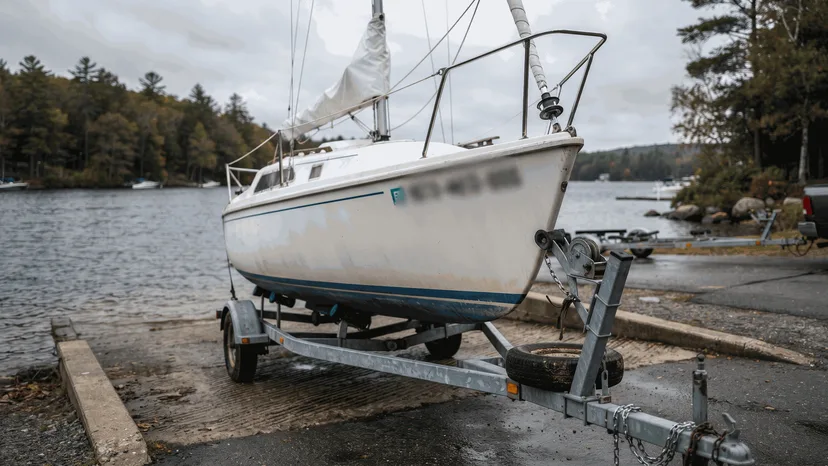
The person in command of a documented vessel must have the original, current Certificate of Documentation on board and produce it when an official asks (46 CFR 67.313, 67.315), except when the boat is in storage or out of the water.
How to Document a Boat, Renew or Cancel
Applying
An owner applying for initial documentation submits the Application for Initial Issue, Exchange or Replacement of Certificate of Documentation, or Redocumentation (form CG-1258), title evidence where applicable and, if there is a mortgage that needs the lender's consent, form CG-4593 (46 CFR 67.141). The NVDC says applications and renewals can be filed through its online eStorefront (NVDC website, read 3 November 2026). The boat must be marked before it is operated under the certificate (46 CFR 67.141(c)).
Title evidence comes in four forms (46 CFR 67.53). The simplified method asks for a copy of the boat's last registration (state, federal or foreign) plus evidence of the chain of title from that registration to you; the complete method asks for the facts of build and an unbroken chain of title from the original owner. The vessel name must use Latin letters or Arabic or Roman numerals and may not duplicate words used to ask for help at sea (46 CFR 67.117).
Fees and Term
The fee table is in 46 CFR 67.550 (eCFR, read 3 November 2026; the table was last amended on 14 November 2023). For recreational vessels it lists:
| Item | Fee in 46 CFR 67.550 |
|---|---|
| Initial Certificate of Documentation, 1-year | $133 |
| Longer initial term (2 to 5 years) | Additional $26 per year |
| Renewal, 1 / 2 / 3 / 4 / 5 years | $26 / $52 / $78 / $104 / $130 |
| Late renewal | $5, in addition to the renewal fee |
| Exchange of certificate (1-year) | $84 |
| Replacement of lost or mutilated certificate | $50 |
| Evidence of deletion from documentation | $15 |
| Abstract of Title (form CG-1332) | $25 |
The multi-year option comes from the Coast Guard's final rule of 14 November 2023 (88 Federal Register 77901, effective 14 December 2023), which says the Coast Guard continues the $26 fee per validity year and that recreational owners choose 1, 2, 3, 4 or 5 years. The NVDC also publishes its own fee schedule, which is the place to confirm current amounts before you pay.
Renewing, Exchanging and Deleting
Renew before the endorsement expires with form CG-1280 (46 CFR 67.163). Renewal may be denied if the owner has an outstanding Coast Guard civil penalty (note to 67.163). The certificate must be exchanged when ownership changes in whole or part, the vessel name or hailing port changes, or other listed events occur (46 CFR 67.167); a change of ownership makes the old certificate invalid immediately.
Deletion takes the boat off the documentation roll. The regulation lists reasons, among them that the owner no longer elects to document the vessel, fails to renew, or fails to keep the markings (46 CFR 67.171). The NVDC issues evidence of deletion on request for the fee above. Whether a state needs that evidence when you move the boat to state registration, or when a buyer wants the boat titled by the state, depends on the state, so ask the state agency before you sell.
Make sure you are on the official site. The NVDC says it is aware of commercial companies that offer to manage the documentation or renewal process for a fee, that the Coast Guard does not endorse them, that they do not act on its behalf, that their fees are not part of the NVDC process and that they are not authorized to issue any form of documentation, including travel letters or permits. In its 2023 rule the Coast Guard also recorded owner complaints that outside companies had charged an additional fee, which it put at an average of approximately $212, and that some owners used them believing they had no other choice. The official documentation pages are on the Coast Guard's dco.uscg.mil site, and complaints can go to the Federal Trade Commission.
Buying a Used Documented Boat
A documented boat has a federal paper trail, and your job as a buyer is to read it before you pay.
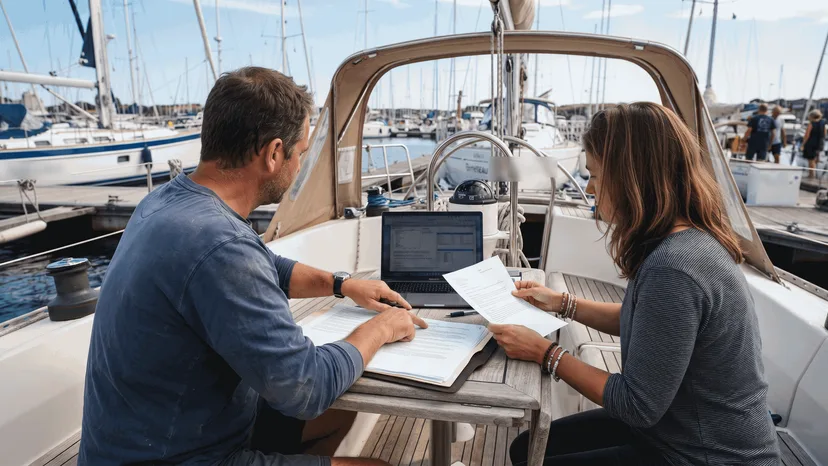
- Ask for an abstract of title. Any person may request one from the NVDC on form CG-1332 (46 CFR 67.301); the fee table lists $25. Mortgages and bills of sale must be filed with the Coast Guard to be valid against other parties (46 U.S.C. 31321), so the NVDC record is where you look for what is on file. Confirm with the NVDC what an abstract covers.
- Check for a recorded mortgage and its release. A satisfaction or release of a mortgage must be filed and signed by the mortgagee (46 CFR 67.265). While a mortgage is outstanding, the certificate generally cannot be exchanged for an ownership change without the mortgagee's consent on form CG-4593 (46 CFR 67.145), so an unreleased mortgage can block your own paperwork. Make sure it is released at closing.
- Match the paperwork to the boat. Compare the name, hailing port, official number and HIN on the certificate, the bill of sale and the boat itself, and check that the markings meet the rules above. A survey is the place for this; see the boat survey process guide.
- Plan the transfer. Ownership changes invalidate the existing certificate (46 CFR 67.167), so the buyer applies for an exchange with title evidence or the boat is deleted and registered with the state, depending on what you want. Decide before closing and agree who files what.
- Allow for age. An older boat may have gaps in its paper history; the older sailboat safety inspection guide covers the physical side.
Frequently Asked Questions
Is Coast Guard documentation required for a sailboat?
Not for a recreational sailboat. Documentation is required for vessels of five net tons or more engaged in fisheries or coastwise trade (46 CFR 67.7), and a recreational vessel that qualifies may be documented at the owner's option. An undocumented sailboat with an engine must instead be numbered by the state (46 U.S.C. 12301).
How big does a boat have to be to be documented?
It must measure at least five net tons. That is volume, not length or weight. The Coast Guard's boater's guide says most vessels over 25 feet measure five net tons or more, but the result depends on the hull's dimensions and shape (46 CFR 69.209).
Does a documented boat need state registration?
It depends on the state. The federal numbering rules do not apply to a documented vessel, but the Boater's Guide says a documented boat may be required to pay a state registration fee and display a state validation sticker, and some states require all vessels to be registered. Washington and Texas, for example, do require documented boats to register. Check your state agency.
How long does a Certificate of Documentation last?
For a recreational vessel, the owner chooses 1, 2, 3, 4 or 5 years when applying or renewing (46 CFR 67.163; 88 FR 77901, 14 November 2023). Other endorsements are valid for one year. A certificate also becomes invalid on events such as a change of ownership.
Can a documented boat be used for charter?
A recreational endorsement covers pleasure use only. A boat with only that endorsement may be bareboat chartered only for recreational use, and the regulation points owners to private legal counsel for the elements of a valid bareboat charter (46 CFR 67.23). Anything beyond that needs advice from the NVDC and a maritime attorney.
Next Steps
Check whether your boat could qualify: get its overall length, breadth and depth and estimate net tonnage with the formula above, then confirm with the NVDC. Read your state agency's page for documented boats to see what registration and decals it still expects. If you are buying a documented boat, request the abstract of title before you commit, line up the mortgage release if there is a loan, and decide in advance whether the boat will stay documented. If you plan to finance, ask your lender first, and arrange insurance on the terms in the sailboat insurance guide. Use only the official Coast Guard site for any filing.