Sail smarter, float better

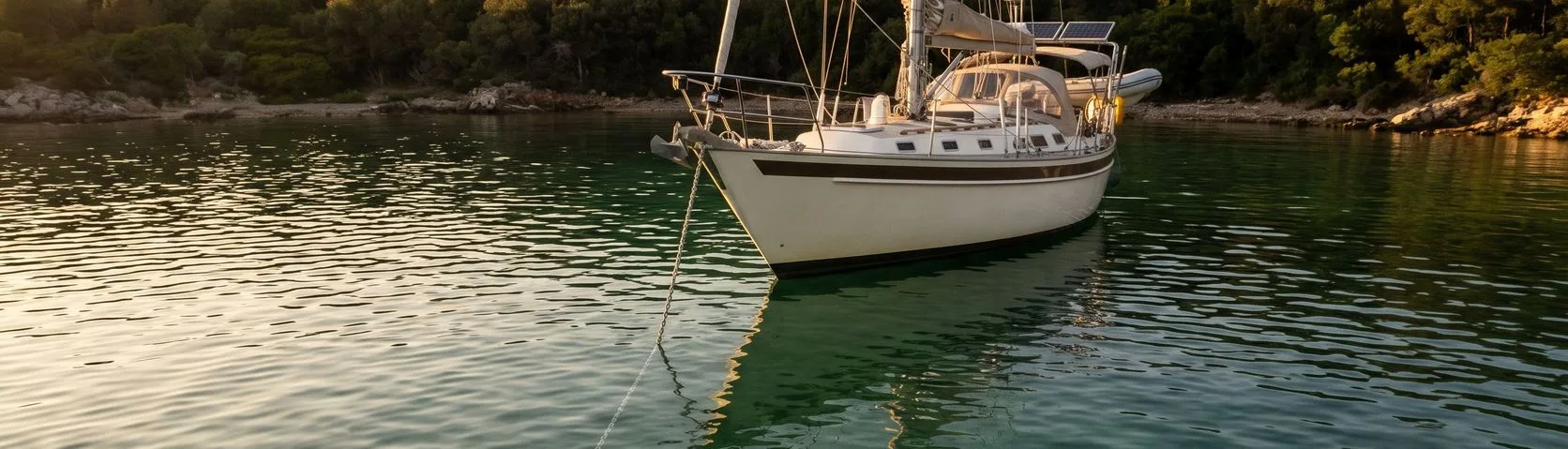
Table of Contents hide
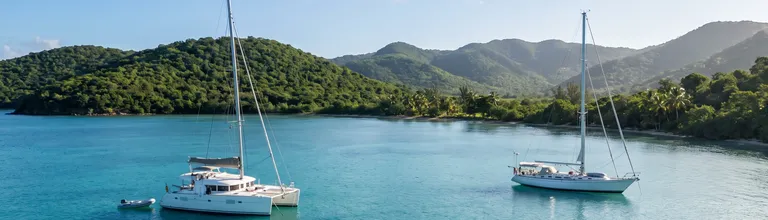
You want to anchor a sailboat for lunch or overnight, and you want it to stay put. Anchoring a sailboat comes down to a few decisions: pick a sheltered spot with a bottom that holds and room to swing, approach slowly into the wind or current, lower the anchor instead of throwing it, pay out enough scope (the ratio of rode length to the depth measured from your bow roller, plus the tide still to come) and back down gently to set it. Then confirm that it holds and keep an anchor watch.
This guide is for sailors in the United States and is general guidance, not a substitute for a boating course or local rules. Sources were read on 7 November 2026; rules change, so check current local rules before you anchor somewhere new.
Key Takeaways
- Scope is the main lever: published guidance commonly cites about 5:1 for all-chain and about 7:1 for chain and rope in moderate conditions, with more in strong wind.
- Set it, then check it: reverse gently, take bearings on fixed objects, and use an anchor alarm as a backup only.
- Know where not to anchor: channels and fairways, cable and pipeline areas, and areas charted or posted as no anchoring.
- Show the light: in US inland waters an anchored vessel must show an anchor light at night and a black ball by day, with narrow exemptions.
Before You Anchor: What You Need
The gear that holds your boat is called ground tackle:
- Anchor. The part that digs into the bottom (types are covered below).
- Rode. The line or chain between anchor and boat, either all chain or chain spliced to rope. Chain's weight helps keep the pull close to the seabed (Practical Sailor, Choosing Ground Tackle for Cruising, updated 7 November 2019).
- Shackles and seizing. Secure the shackle pin with seizing wire or a cable tie, and tie the inboard end of the rode to the boat so it cannot run out.
- Snubber or bridle. A stretchy line that takes the load off a chain rode (see below).
- Bow roller or windlass. A roller guides the rode over the bow; a windlass is a powered or hand-cranked winch that hauls in the anchor and rode.
- Depth sounder, chart and gloves.
The sailing safety equipment list covers the rest of the gear aboard, and the advanced sailing knots guide shows knots for securing rode and lines.
Choosing Where to Anchor
- Shelter. Plan for the wind and swell forecast for the next day, including a likely shift.
- Depth and tide. Check low tide so you do not ground, and high tide so your rode still has enough scope.
- The bottom. The Boat-Ed boater course tells students to choose a well-protected area with adequate depth and a sandy or muddy bottom (Boat-Ed, Michigan Boater Safety Course, anchoring review).
- Swing room. Your boat swings around the anchor in a circle set by the rode you let out. Keep it clear of other boats, shoals and the shore.
The chart legend, NOAA's U.S. Chart No. 1 (13th edition, 15 April 2019), explains the symbols. Section J gives seabed abbreviations such as S (sand), M (mud), Cy (clay), R (rock), Wd (weed) and Sg (seagrass). Section N shows anchorage areas and the symbol for an anchoring prohibited area; Section L covers submarine cable and pipeline areas. Section K covers foul ground, which the legend describes as safe for navigation but to be avoided by vessels anchoring.
Where You Should Not Anchor
Boat-Ed's anchoring article (How to Anchor a Boat, 30 March 2026) answers the common exam question "where should you avoid anchoring" with channels near bridges, docks or boat ramps, coral reefs, seagrass beds, underwater cables, areas marked no anchoring, and places with strong currents or little swing room. Together with the chart legend and the Navigation Rules:
- Channels and fairways. Rule 9 says a vessel shall, if circumstances admit, avoid anchoring in a narrow channel (Inland Rule 9(g), 33 CFR 83.09). Boat-Ed adds shipping lanes.
- Cable and pipeline areas. Charts mark them.
- Restricted or prohibited areas, including charted or posted no-anchoring areas and the naval, military and private areas Boat-Ed lists.
- Near docks, launch ramps and moorings. You block traffic and risk fouling.
- Over sensitive seagrass or coral where protected. The RYA, the UK's sailing body, points boaters to The Green Blue's Anchoring with Care guidance on seabed habitat (RYA anchoring and mooring). US local rules may add protected areas.
- Lee shores with an onshore forecast. A lee shore is the shore the wind blows you toward.
Local rules vary by state and harbor; check the local boating agency and harbormaster. Federal special anchorage areas are listed in 33 CFR part 110, subpart A. For Chesapeake Bay stops, see the Chesapeake Bay anchorages list.
How to Anchor a Sailboat Step by Step
This is the usual routine under power, and it matches the core steps in the Boat-Ed boater course.
- Prepare the anchor and rode. Free the anchor, flake the rode so it runs clear and check the inboard end is secured.
- Approach slowly, head to wind or current. Motor into the stronger of the two and stop with the bow at your chosen spot.
- Lower the anchor to the bottom. Lower it; do not throw it, which can foul the rode or hurt a hand.
- Drift or back slowly while paying out rode. Feed it out so it does not pile on the anchor.
- Snub briefly so the anchor bites. After a few lengths are out, hold the rode for a moment so the anchor digs in.
- Let out the full scope. Pay out the rest (see the next section) and make it fast on a strong cleat.
- Set the anchor with gradual reverse power. The rode should stay taut and the boat should stop moving back.
- Check your position and set an anchor alarm. Take two bearings or transits (lines between fixed objects, such as a pier end and a tree). Boat-Ed's course says to recheck such sightings often to detect dragging.
- Rig the snubber. On a chain rode, attach it and ease the chain until the snubber takes the load.
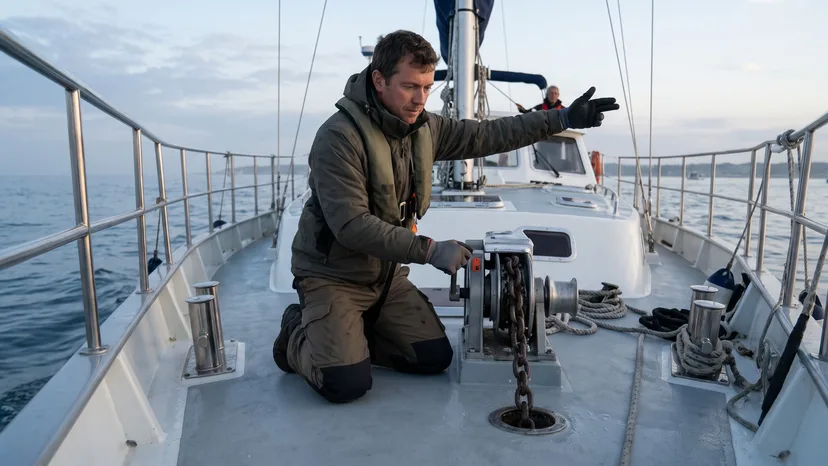
Agree hand signals with your crew beforehand, because engine and wind noise make shouting unreliable: a pointed arm for direction, a flat hand for stop.
Anchoring under sail without an engine is an advanced technique. It needs a roomy anchorage, calm conditions and practice, preferably with an instructor.
How Much Scope Do You Need?
Scope = rode length ÷ (water depth + bow roller height above the water + tide rise)
Anchor maker Mantus defines scope as the ratio of rode length to depth and says enough scope keeps the strain close to parallel with the seabed (Mantus chain sizing page). The NauticEd sailing school measures from the bow roller to the seabed and adds expected tide (Anchoring Rode and Scope).
The commonly cited ratios are guidance, not rules, and they differ by source:
- SAIL Magazine: 5:1 for all chain, 7:1 for rope and chain, 10:1 for all rope (Setting Tandem Anchors, 30 March 2015).
- Boat-Ed: 5:1 to 7:1 in its article; seven to ten times the depth in its boater course.
- Practical Sailor: three to one as a minimum, five to one better, seven to one better still.
- Mantus: 10:1 preferable in windy conditions.
Chain needs less scope than rope, and every source adds scope as the wind builds. Using less in a crowded anchorage costs holding power: Mantus's table shows an anchor holding about 40 percent of its maximum at 3:1 and about 70 percent at 6:1.
Worked example with invented depths, a bow roller 4 ft above the water in each case:
| Water depth | Bow height | Tide rise to come | Total | Rode at 5:1 | Rode at 7:1 |
|---|---|---|---|---|---|
| 10 ft | 4 ft | 2 ft | 16 ft | 80 ft | 112 ft |
| 20 ft | 4 ft | 3 ft | 27 ft | 135 ft | 189 ft |
| 30 ft | 4 ft | 1 ft | 35 ft | 175 ft | 245 ft |
How Much Anchor Chain Do I Need?
The scope sums give total rode; how much must be chain depends on your design. Size it for the deepest water you plan to use, with a margin: the table needs 189 ft for 7:1 in 20 ft of water and 245 ft in 30 ft. Mantus recommends at least 300 ft of rode on an average cruising boat, enough for 10:1 in 25 ft. With a rope rode, a length of chain next to the anchor is standard: Practical Sailor's author recommends at least 12 feet of heavy chain ahead of 200 or more feet of nylon for a Danforth-type anchor, while Boat-Ed's boater course suggests 7 to 8 feet of galvanized chain (anchoring review).
How to Tell If Your Anchor Is Dragging
An anchor is dragging when it slides along the bottom because it never dug in or has pulled out. Common signs:
- Bearings or transits change. The fixed objects you lined up have moved apart. This is the most reliable check.
- The anchor alarm sounds. A chartplotter alarm sounds when you move beyond a radius you set (Garmin GPSMAP manual).
- The boat lies differently from its neighbours. Others hold their heading while yours lies across the wind.
- Chain noise or vibration through the rode or hull.
Set the alarm radius from your scope with a margin for GPS error, and treat it as an aid. The sailing apps guide covers apps and chartplotter features that include anchor alarms.
If you drag: wake the crew and start the engine, check for clear water and boats downwind, then recover and re-anchor with more room and scope. Letting out more scope helps only if there is room and the anchor is still in the bottom. If conditions are worsening and holding is poor, leave for shelter. An anchor watch means someone stays alert to check position, weather and neighbours at intervals, especially when wind is rising or shifting.
Anchoring in Strong Wind
- More scope. Boat-Ed's course says seven to ten times the depth and Mantus says 10:1 is preferable in wind.
- The engine ready. Know it starts and be prepared to use it.
- A second anchor, as an option only. SAIL says tandem anchors are not a substitute for an adequately sized main anchor and advises waiting for wind and seas to moderate before recovering them. Rocna says one properly sized anchor on one good rode is the ideal and that most boaters should never have cause for tandem anchoring (Rocna knowledge base).
- Know when to leave. If the anchorage is exposed to the forecast wind, move to shelter before it builds.
Using a Snubber or Bridle
A snubber is a stretchy rope, usually nylon, connected to the chain so it takes the load instead of the chain. It absorbs shock, takes strain off the windlass and bow roller, and quiets the jerking of chain. Mantus says a snubber can reduce shock loads by a factor of three, but that rode strength should cope alone because a snubber cannot be relied on in a storm. A bridle is a snubber with two legs, one to each side of the bow; Practical Sailor says sharing the load reduces tension at each attachment point and helps limit yawing (Adjustable Snubber Bridle and Chain Hook, 23 April 2020).
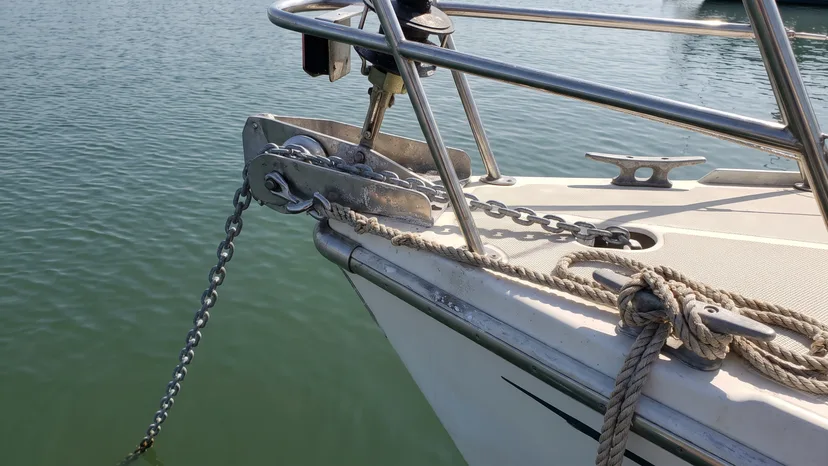
- Attach with a chain hook or rolling hitch. A hook clips onto a link; a rolling hitch is a knot tied to the chain. Practical Sailor notes that many leisure hooks can stress a chain link or damage its galvanizing, so size the hook to your chain.
- Make it long enough that the hook stays well clear of the bottom. Practical Sailor's reviewers ran 15 to 20 metres on their catamaran and up to 30 metres in stronger wind, and note that lengthening a snubber is one of the easiest ways to add shock absorption.
- Protect it from chafe at the roller or fairlead, and replace it when worn.
- Do not let the windlass hold the boat. Practical Sailor says never to rely on the chain on the windlass if the snubber fails; use a chain stop or cleat.
Anchor Types in Brief
No type is best on every bottom. Size your anchor from the maker's sizing chart.
| Type | Good for | Weaknesses |
|---|---|---|
| Fluke (Danforth-type) | Soft sand or mud; Practical Sailor says its sharp flukes dig in well. Lightweight. | Practical Sailor ties it to soft bottoms, so other bottoms may need another design |
| Plough (CQR-type) | Practical Sailor says the pointed tip more reliably digs into eel grass or kelp | Results vary with the seabed; compare current independent tests before choosing |
| Claw (Bruce-type) | Mud and sand; a good setter in Practical Sailor's earlier tests | Slid over kelp and eel grass in Practical Sailor's use |
| New-generation (Rocna, Mantus, Spade and similar types) | Practical Sailor's tests found concave-fluke designs such as the Spade, Rocna and Manson set quickly and have good holding power (Anchor Testing and Rode Loads) | Results differ by bottom: Practical Sailor found some roll-bar designs set poorly in very soft mud (Anchoring in Squishy Bottoms) |
| Grapnel | Sometimes used on rocky bottoms, per Practical Sailor | Hard to stow; Practical Sailor calls it dangerous to ankles and toes |
| Mushroom | Small canoes, rowboats, small sailboats and inflatables, per Boat-Ed | Weak holding; Boat-Ed says never to depend on one in rough water or weather |
Boat-Ed's boater course says plough and fluke styles are each good for most boats, the usual answer to the exam question "which anchor is a good choice for most recreational boats." Practical Sailor reports that newer concave-fluke designs set and hold well, with the caveats above.
Raising the Anchor
- Start the engine and agree signals so the bow tells the helm which way the rode leads.
- Motor slowly toward the anchor while taking in rode. Let the windlass or crew lift the anchor and rode, not drag the boat; check your windlass manual for its limits.
- Break the anchor out vertically. Boat-Ed's course says to move the boat directly over the anchor; pulling straight up should free it.
- Clean the anchor and chain of mud as they come up.
- Stow and secure the anchor so it cannot move under way.
If the Anchor Is Stuck
Boat-Ed's course says to circle the boat with the line kept taut; when the anchor breaks loose, stop and retrieve it. On a sailboat, motor over the anchor and pull from the opposite direction to the one in which it was set. A trip line is a light line from the back of the anchor, often to a marker buoy, that lets you pull the anchor out backwards. Rig it before you anchor; it adds a line that can foul a prop. If nothing works, buoy the anchor and ask a salvage or diving service rather than risk the boat or crew.
Anchor Lights and Day Shapes
This section covers US inland waters, where the Inland Navigation Rules apply. Seaward of the COLREGS demarcation lines the International Rules apply with separate wording, so check the USCG Navigation Rules for the water you will use.
- The rule. Rule 30 requires a vessel at anchor to show, where it can best be seen, an all-round white light or one ball in the fore part, and an all-round white light at or near the stern at a lower level (Inland Rule 30, 33 CFR 83.30(a), checked 7 November 2026). A vessel under 50 metres may show one all-round white light instead (paragraph (b)). By day the ball is black and at least 0.6 metre across, though smaller shapes may be used on vessels under 20 metres (33 CFR 84.06).
- Small-vessel exemption. Paragraph (e): a vessel of less than 7 meters in length, when at anchor, not in or near a narrow channel, fairway, anchorage, or where other vessels normally navigate, shall not be required to exhibit the lights or shape prescribed in paragraphs (a) and (b). Seven metres is about 23 feet.
- Special anchorage areas. Paragraph (g): a vessel of less than 20 meters in length, when at anchor in a special anchorage area designated by the Coast Guard, shall not be required to exhibit the anchor lights and shapes required by the rule. The areas are in 33 CFR part 110, subpart A. If you are not sure you are inside one, show the light.
Common Anchoring Mistakes
- Dropping the anchor while moving fast, so the rode runs out in a heap.
- Letting the chain pile on the anchor, which cannot then dig in.
- Not setting the anchor with a gentle reverse.
- Anchoring too close to others. SpinSheet reports a suggestion of about three boat lengths, and warns that dragging is dangerous when everyone is below asleep (10 Tips for Anchoring a Sailboat, 3 July 2025).
- Ignoring the forecast wind shift. A calm anchorage can be exposed in a few hours.
- No anchor watch. Alarms fail; check your bearings.
Frequently Asked Questions
What is the 7:1 rule for anchoring?
A rule of thumb: let out seven feet of rode for every foot of depth, measured from the bow roller to the seabed. SAIL gives 7:1 for a rope and chain rode, so it is a common baseline, not a regulation. Use more in strong wind.
How much anchor chain do I need?
Work out total rode from your scope and the deepest water you will anchor in, as in the worked example. How much is chain depends on your rode design; use your anchor maker's guidance for chain size and length.
Can you anchor a boat anywhere overnight?
No. You cannot anchor in a channel or fairway, in cable or pipeline areas, in areas charted or posted as no anchoring or restricted, or on private property without permission. Some states and harbors set their own limits or require moorings, so check the chart, the local boating agency and the harbormaster.
Can you leave an anchored boat unattended?
Staying aboard is the safe default, because an unattended boat relies on the anchor, scope, weather and neighbours all staying as they were. If you must leave, use extra scope, check the forecast, set an alarm someone can respond to and check local rules, as some harbors limit unattended anchoring.
What is the difference between anchoring and mooring?
Anchoring uses your own anchor and rode, which you set and recover. A mooring is a permanent ground anchor with a buoy that you tie up to. The RYA notes that traditional swing moorings can create a damaging "dead zone" where their chains sweep the seabed.
How big should my anchor be?
Use the anchor maker's sizing chart, which is based on boat length and displacement and the wind you want to hold in, and which differs by design. Practical Sailor's author generally chooses one size larger than the maker recommends, but that is one person's habit, not a rule.
Next Steps
Practise before you need it. Pick a quiet, known anchorage on a calm day with plenty of daylight and run the whole routine: approach, drop, set, check, snubber and raise. Plan each anchorage with the chart and forecast, with a backup in case the wind shifts. If you will anchor in soft bottoms on the Chesapeake, read anchoring in Chesapeake Bay mud next.