Sail smarter, float better

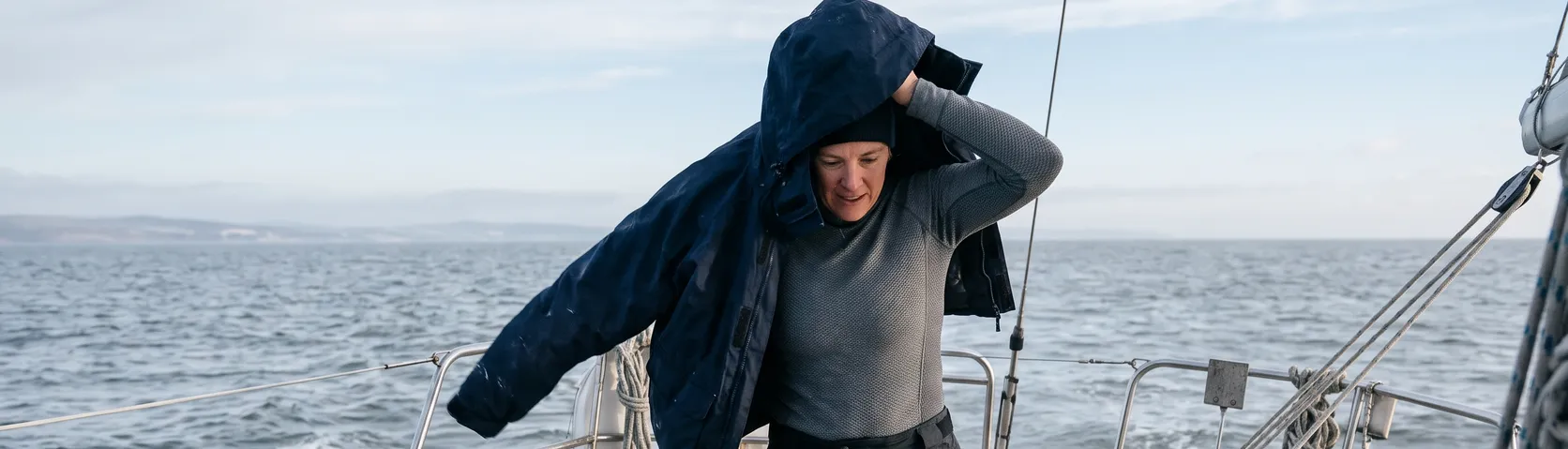
A base layer is the thin top and leggings you wear next to your skin, under your fleece and foul weather gear. On a boat its job is to move sweat away from your skin and keep you warm when you are damp, whether you are grinding a winch or sitting still on a night watch. Most sailors choose between merino wool and synthetic fabrics such as polyester or polypropylene. The short answer: merino stays comfortable when damp and smells less over several days, synthetics dry faster and usually cost less, and blends sit in between. The fabric weight then follows the temperature and how hard you are working.
This guide helps you pick the fabric and weight for the sailing you do and shows what to look for on a product page. It does not rank products. Sources were read on 16 November 2026.
Key Takeaways
- Merino for comfort over days: it absorbs moisture vapour into the fibre, stays warm when damp and builds up less odour than polyester.
- Synthetic for wet, active sailing: polyester and polypropylene hold little water and dry faster, which suits dinghies, racing and frequent washing.
- Weight follows temperature: about 150 g/m² merino for mild days, about 185-200 g/m² for cool days and about 230-250 g/m² for cold sailing, using makers' own bands.
- Skip cotton: it holds water and stops insulating once wet.
- Fit close, not tight: a base layer has to touch your skin to move moisture, but should not restrict movement under bibs or a life jacket.
What a Base Layer Does on a Boat
On land you can walk to stay warm. On a boat you swing between hard work, such as tacking, reefing or hauling the anchor, and long periods sitting still in wind and spray. Sweat that stays on your skin after the hard work chills you once you stop moving. A base layer moves that moisture away from your skin and into the layers above, where it can evaporate through a breathable shell.
It is one part of a system. Gill's layering guide describes the base layer as the layer that moves moisture away from the skin, with a mid layer for insulation over it and an outer layer as the shield against wind and water. Our cold-weather layering guide for sailors covers the full system, and the difference between a midlayer and an outer layer is explained separately.
Merino or Synthetic Base Layer for Sailing?
Choose merino if you sail for several days without washing, spend long hours on watch and value comfort when slightly damp. Choose synthetic if you get soaked often, sail dinghies or race, want fast drying and a lower price. Many sailors own both. The table summarises the differences that the sources below describe.
| Property | Merino wool | Synthetic (polyester, polypropylene) | Blends |
|---|---|---|---|
| Moisture | Absorbs vapour into the fibre; up to about a third of its weight before feeling wet | Absorbs very little; moves liquid sweat along the fabric | In between, depending on the mix |
| Warmth when damp | Stays comfortable when damp; releases a little heat as it absorbs moisture | Warm while drying, cool once wet through | In between |
| Drying speed | Slower | Faster | Usually faster than pure merino |
| Odour | Builds up less odour than polyester | Polyester holds odour the most | Depends on the share of wool |
| Durability | Thin, lightweight knits wear faster | Generally hard-wearing | Synthetic content is often added for strength |
| Price level | Higher | Lower | Usually between the two |
Why merino works on a boat
Wool takes up water vapour inside the fibre. The Science Learning Hub (University of Waikato) states that wool can absorb up to 30% of its weight in water without feeling wet, and that it produces heat as it absorbs moisture. The Woolmark Company, the wool industry body, puts the figure at up to 35%. That is why merino feels less clammy when you sit down after hard work, and why it suits long watches.
Merino also smells less. Research by Rachel McQueen, reported by the University of Alberta, found polyester to be the smelliest of the fabrics tested and merino wool the least. A later study from the same researcher, covered in 2024, found wool takes up odour but releases it more quickly than polyester. So the fair claim is "less smelly than polyester", not odour-free. Woolmark says wool can be worn multiple times without laundering, which is useful on a boat with limited water, but how long depends on you and the conditions.
Merino's drawbacks
Merino has real downsides. Practical Sailor names slow drying as wool's main problem for sailors. Outdoor Life cites a test showing that pure merino can take up to 40% longer to dry than polyester and that thin merino garments wear out faster. It also costs more than most synthetics. If your base layer gets soaked by water rather than sweat, merino will stay wet longer.
Why synthetics work on a boat
Polyester and polypropylene absorb almost no water, so sweat moves along and through the fabric and evaporates quickly. Practical Sailor prefers synthetic base layers for that reason, and Outdoor Life lists better wicking, faster drying and lower cost as their advantages. The trade-off is odour: polyester holds smells more than wool, so on a multi-day trip you will want to rinse it or carry spares.
Blends
Blends try to combine the two. Some mix merino with polyester, polypropylene or nylon in the same knit; others use two layers, synthetic on the inside to move sweat and wool on the outside for warmth. Makers state the mix on the label, so check the percentages: a top with only a small share of merino behaves mostly like a synthetic.
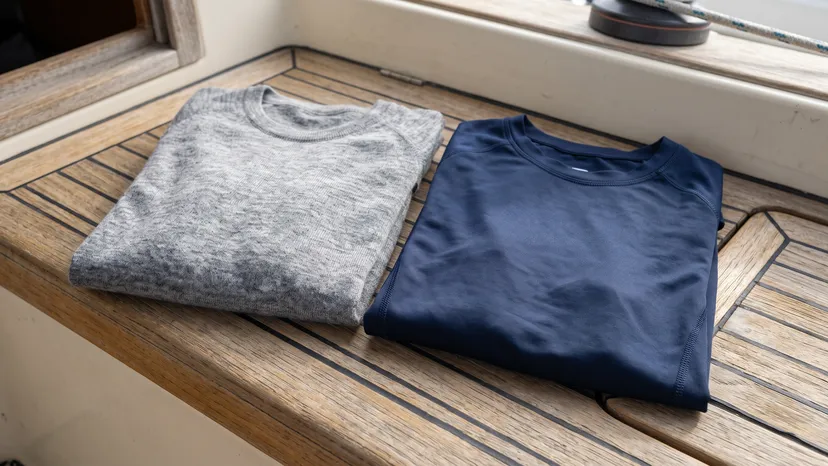
Choosing the Weight: 150 vs 200 vs 260 Merino
Merino base layers are often described by fabric weight in grams per square metre (g/m², often written gsm). A higher number means a thicker, warmer fabric. Makers group the weights into bands, but they do not use the same names:
- About 150 g/m²: Ortovox describes 120-150 g/m² as ideal for warm days, and Smartwool labels its 150 g/m² merino-blend layer as lightweight. On a boat this suits summer evenings, sun cover and active sailing in mild weather.
- About 185-200 g/m²: Ortovox describes 185 g/m² as covering a broad temperature range. This is the most versatile band for spring and autumn sailing.
- About 230-250 g/m²: Ortovox calls 230 g/m² ideal for cold days, and Smartwool labels 250 g/m² as midweight. This suits winter sailing and night watches.
Check what the number in a product name means. Smartwool's figures are fabric weights in g/m², but Icebreaker says the numbers in its product names are a heat index of warmth, on which 200 is midweight and 260 heavyweight. A "200" from one maker is not the same as 200 g/m² from another. An Icebreaker "260" top sits in its heavyweight class, a step above its 200 midweight; that much warmth suits very cold sailing or long, still watches.
Synthetic base layers usually do not state a fabric weight. Makers describe them by class instead, such as lightweight, midweight or thermal. Compare thickness within one maker's range rather than across brands.
Two practical points. First, on cold days a light base layer under a good fleece often works better than one heavy base layer, because you can take the fleece off when you start working. Second, if you sail in sunshine, a light long-sleeve base layer also covers your arms; check the product page for a stated UPF rating rather than assuming one.
Base Layers for Different Kinds of Sailing
Dinghy sailing and racing
Dinghy sailors and racing crews get wet and work hard, so fast drying matters most. Synthetic or thermal synthetic tops are the usual choice. Under a wetsuit, Gill's base layer guide recommends its Hydrophobe base layers, made from polypropylene that does not hold moisture, for insulation under a wetsuit or drysuit, and the sailing maker Rooster's layering guide notes that a plain rash vest, which stays wet, has a cooling effect, while thermal layers are made to go under neoprene. In colder months, Practical Boat Owner mentions long-sleeved thermal rash vests as an option.
Under a drysuit
A drysuit keeps water out, but the warmth comes from what you wear under it. Practical Boat Owner's dinghy clothing guide describes the drysuit as standing in for both the mid layer and the outer layer. Typhoon, a drysuit maker, describes its all-in-one undersuits as designed to keep you warm underneath a drysuit. Underneath, wear a wicking base layer and, in cold weather, a fleece undersuit or mid layer. A wicking base layer next to the skin keeps sweat from soaking the undersuit.
Coastal day sailing
Day sailors can change clothes or head home, so either fabric works. A versatile 150-200 g/m² merino or a midweight synthetic, with a fleece and a waterproof jacket on top, covers most spring and autumn days. The sailing attire guide covers what else to bring.
Under foul weather gear, offshore and on night watches
Under a sailing jacket and trousers, the standard order is base layer, then one or more mid layers, then the waterproof shell. Yachting World's guide to offshore clothing recommends polyester or merino base layers, mid layers for insulation and waterproof jacket and trousers on top. Offshore and on overnight passages you sit still for hours and cannot wash much, which is where merino's warmth when damp and lower odour help. Carry a dry spare base layer in a waterproof bag. For the shell itself, see our guide to waterproof sailing gear for cold weather.
Women's Sailing Base Layers and Thermals
"Thermals" and "base layers" mean the same garment: the layer worn next to the skin.
Several makers in the table below list women's versions of their base layers, cut and sized separately from the men's range. Because sizing differs from maker to maker, use each maker's own women's size chart rather than your usual size.
The main sailing-specific issue is what goes on top. In a Practical Boat Owner column, sailor and author Marsali Taylor writes that many so-called women's sailing trousers were simply resized men's, and describes how drop-seat trousers solved the problem of bib straps over several layers. When you choose base layers to wear under them, check:
- Whether the top is long enough to stay tucked under bib trousers or salopettes when you bend, so no cold gap opens at your lower back.
- Whether the waistband of the leggings sits comfortably under the bib and, if you wear one, under your harness or life jacket.
- Whether a separate top and leggings suit your trousers better than a one-piece, especially if your foul weather trousers have a drop seat.
What Sailing Makers Publish
The table lists base layer tops from four sailing makers and three outdoor makers, with the fibre content and weight exactly as each maker states them on its own product page. It is not a ranking and none of these products has been tested by Salty and Windy. Most makers do not give a fabric weight, which is itself worth knowing when you compare.
| Maker and product | Type | Fibre content (as stated) | Weight (as stated) |
|---|---|---|---|
| Helly Hansen LIFA Merino Midweight Crew | Two-layer blend | 57% merino wool, 43% polypropylene | "Midweight" (no g/m²) |
| Musto HPX Merino Baselayer Long-Sleeve Top | Merino with synthetic panels | Main fabric 100% merino wool; second fabric 85% polyamide, 15% elastane | Not stated |
| Musto Thermal Base Layer Top 2.0 | Synthetic | Main fabric 94% polyester, 6% elastane; second fabric 78% polyamide, 22% elastane | Not stated |
| Gill Base Layer Top | Synthetic | 85% recycled polyester, 15% spandex | Not stated |
| Zhik Superthermal Hydrobase Top | Synthetic | 50% polypropylene, 40% polyester, 10% elastane | "Lightweight" (no g/m²) |
| Icebreaker Merino 200 Oasis Long Sleeve Crewe | Merino | 100% merino wool | "200" on Icebreaker's heat index, classed midweight (not g/m²) |
| Smartwool Classic Thermal Merino Base Layer Crew | Merino | 100% merino wool | Midweight, 250 g/m² |
| Patagonia Capilene Midweight Crewneck | Synthetic | 100% recycled polyester | Midweight; fabric stated as 4.1 oz (140 g) |
The links go to the men's or unisex versions. Helly Hansen, Icebreaker, Smartwool and Patagonia list women's versions of these tops, and Gill sells a separate women's long-sleeve crew neck. Details such as the fabric mix change between model years, so read the current product page before you buy.
What to Check Before You Buy
- Fibre content: the exact mix on the label, for example 100% merino, a merino-synthetic blend or 100% polyester.
- Fabric weight: g/m² for merino; the maker's weight class for synthetics.
- Seams: flat seams, which sit flush and are less likely to rub under a harness, life jacket or rucksack straps.
- Length: a longer back so the top stays tucked in when you bend or reach.
- Cuffs and neck: thumb loops or snug cuffs to keep sleeves in place under jacket cuffs; a crew neck, zip neck or high collar depending on how cold you sail.
- Sizing chart: the maker's own chart for men's or women's cuts.
- Care label: washing temperature and drying instructions. The layering guide explains how to care for base layers.
For how a base layer should sit on your body under the other layers, see how a sailing base layer should fit.
Frequently Asked Questions
Are merino base layers good for sailing?
Yes, especially for cruising, offshore passages and night watches. Merino absorbs moisture vapour, stays comfortable when damp and builds up less odour than polyester. It dries more slowly and costs more, so for very wet, active sailing a synthetic may suit you better.
Should I wear merino or synthetic for sailing?
Merino suits long, cool or multi-day sailing where comfort and odour matter. Synthetic suits dinghy sailing, racing and anything that gets soaked, because it dries faster and is usually cheaper. Many sailors own one of each.
Is merino warm when wet?
Merino stays comfortable when damp because it absorbs moisture into the fibre and gives off a little heat as it does. Once soaked through with water, it loses warmth and dries slowly like any wet fabric. Change into a dry layer when you can.
What weight of base layer do I need?
As a rough guide from makers' own bands: about 150 g/m² merino for warm or mild days, about 185-200 g/m² for cool days, and about 230-250 g/m² for cold sailing. For synthetics, and for makers whose product numbers are not fabric weights, use the maker's lightweight, midweight or heavyweight classes.
What base layer is best for winter or cold-weather sailing?
A 230-250 g/m² merino (Smartwool classes 250 g/m² as midweight; Ortovox calls 230 g/m² its cold-days weight) or a thermal synthetic, under a fleece mid layer and a waterproof shell. On long watches merino's comfort when damp helps; in a dinghy or drysuit, a thermal synthetic dries faster.
How many days can you wear a merino base layer?
There is no fixed number. Makers and the wool industry say merino can be worn several times between washes because it builds up odour more slowly than polyester. On a boat it depends on how much you sweat, how wet it gets and whether you can air it.
Should a base layer be tight or loose?
Close-fitting, but not tight. It has to touch your skin to move moisture away, but it should not restrict movement or bunch under your other layers. The layering guide covers base layer fit in more detail.
Can I wear cotton as a base layer?
Avoid it. Cotton absorbs water and dries slowly; the US National Park Service's hypothermia advice says cotton is useless as insulation once wet. For cold water and hypothermia risks, see the cold-water caveat in our layering guide.
Next Steps
Decide which kind of sailing you do most, pick the fabric from that, and choose the weight for your coldest typical day. Then check fibre content, weight, seams, length and the maker's size chart on the product page. Add a fleece mid layer and a waterproof shell on top, and keep one dry spare base layer on board.